


How to Hunt Yellowtail: The West Coast Diver's Complete Species Guide

Updated: Apr 12
Yellowtail (Seriola lalandi) is the fish most West Coast divers dream about. Big, fast, and incredibly powerful, a quality yellowtail will test everything from your breath-hold to your shooting judgment. I've chased yellowtail off the California coast and down into Baja, and I can honestly say there's no other hunt quite like it. The speed of the chase, the depth you often need to reach them, and the sheer size of a big YT makes landing one a genuinely hard-earned achievement.
What Makes Yellowtail Such a Prized Target
Yellowtail are the intersection of challenge and reward. They're fast enough to make a bad shot attempt obvious, big enough that a clean kill requires real technique, and smart enough to push off pressure quickly. On top of that, they're exceptional eating--rich, firm-fleshed, and perfect for sashimi or the grill. Once you've hunted them seriously, almost every other inshore species feels a little easy by comparison.
Yellowtail Behavior and Season
Yellowtail school behavior changes dramatically with the season. In spring, smaller fish cruise kelp beds close to shore. By summer, when the water warms and bait shows up, mature fish push offshore and hold around structure--kelp paddies, oil platforms, seamounts, and subsurface ledges. Water temperature is your biggest indicator. Yellowtail activate when surface temps hit the mid-60s Fahrenheit and really turn on above 68 degrees F.

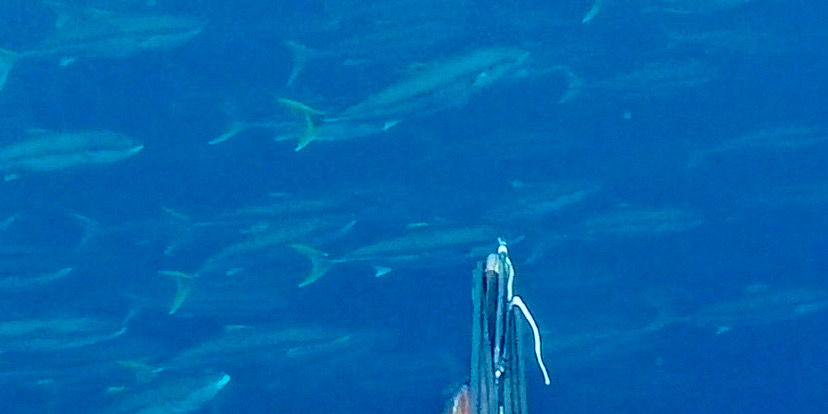
On any given dive, you'll find yellows moving in a loose school through the water column. Unlike white seabass, which tend to stay deep and slow, yellowtail often move fast and high. They'll ghost in from the blue, cruise your chum line, and disappear just as quickly. Your ability to read their body language--whether they're spooked or curious--determines whether you get a shot.
Gear Setup for Yellowtail
For yellows in the 15 to 30 lb range that you'll find around kelp and nearshore structure, a 110 to 120cm speargun with two bands will handle most situations. When you're hunting big yellowtail in Baja or offshore around structure--fish pushing 40, 50, or 60 lbs--step up to a 130cm or a railgun setup with three bands. You need a shaft with enough mass to punch through a big fish cleanly.
I use a 7mm or 7.5mm shaft for most yellowtail hunting. Flopper tips work fine for smaller fish, but on big yellows I prefer a slip tip with a breakaway setup--these fish will thrash hard enough to pull a flopper back through the body if your shooting angle isn't perfect. Aim for the mid-body kill zone, just behind the gill plate, to hit the spine or heart-lung area. For gun deals, check out Hot Rod Spearguns and use promo code spearfactor for 10% off.
A long float line--at least 30 feet--is non-negotiable. Big yellowtail will run hard and dive deep after a hit. You do not want to be tethered to a wild 40-pound fish with a short line. Keep your gun connected to the float line and your float connected to a dive flag. These fish will run, so be ready. As part of your safety setup, the Provitatec Sens07vest recovery vest is worth considering--use promo code SPEARFACTOR10 for a discount.
Diving Strategy and Shot Placement
The most effective method for hunting yellowtail is chumming the surface, then dropping once fish come in. Most successful yellowtail hunts happen between 20 and 50 feet--shallow enough to make it a realistic freedive shot but deep enough that the fish feel comfortable. When you spot the school from the surface, time your drop for when the fish are holding, not running.
Shot placement matters enormously with yellows. The best shot is a broadside hit just behind and below the gill plate, aimed at the lateral line. This puts your shaft through the spine or through the heart-lung cavity, which anchors the fish quickly. A gut shot on a big yellowtail means you're in for a long fight and a potential loss if your float setup isn't solid.

Stay calm on your descent. Yellowtail are cautious fish. Any fast or jerky movement will push them off. Use a slow, stalking descent with your arms at your sides, gun already pointed, and try not to kick until you're within 10 feet of your target. Once there, wait for the shot you want--not the first opportunity that presents itself.
Where to Find Yellowtail
The best yellowtail spots on the California coast are around the Channel Islands--Catalina, San Clemente, and Santa Cruz Islands in particular. The kelp beds around these islands hold fish all summer. Farther south, Baja California is legendary for yellowtail. The Coronado Islands just across the border from San Diego are accessible by boat and produce quality yellows from late spring through fall.
Offshore, look for temperature breaks, kelp paddies, and subsurface current lines. Yellowtail use these as highways. Your fish finder is your friend here--mark bait schools and look for the larger marks below or around them. Where the bait is, the yellows won't be far. Refer to our guide on how to read a fish finder for spearfishing if you want to get more out of your sonar setup.
After the Hunt
Yellowtail deteriorates fast in warm water. Spike the fish immediately after landing it--right through the brain with a dive knife--and get it on ice within minutes. Keep an insulated bag with slush ice on the boat specifically for yellows. Properly iced fish keeps for two to three days and is excellent for sashimi, ceviche, or grilled over charcoal.

Level Up Your Yellowtail Game
If you're serious about hunting big yellowtail, technique is everything. Improving your breath-hold, your descent speed, and your underwater composure will put more fish in the bag than any gear upgrade. The SpearFactor Master Class at spearfactor.com covers the hunting fundamentals that apply directly to yellowtail--from chumming strategy to shot placement to float rig setup. If you're planning a California kelp trip or a Baja run, this is where you start.
Also make sure your safety protocols are dialed in before any yellowtail trip. Grab the free Emergency Procedures checklist at SpearFactor.com and review it with your dive buddy before you get in the water. Yellowtail hunting involves depth, strong current, and big fish--knowing what to do if something goes wrong is part of the preparation, not an afterthought.
Check Conditions Before You Go
Check current visibility, water temperature, and fish activity predictions at your dive spot using the SpearFactor Fish & Dive Conditions Tool.


Comments