


The Stone Shot: Shot Placement for Instant Kills on Spearfishing

Every diver has felt it. You line up a shot on a yellowtail, the shaft flies, the fish lights up the water in a panicked run, and suddenly your float line is smoking off the reel and the fish is boring for structure. Sometimes you land it. Sometimes you find a wrapped, broken shaft on a rock the next tide, or watch a seven-gill shadow materialize out of the blue. The difference between those two outcomes is almost always shot placement. More specifically, it is whether or not you placed a stone shot.
What a Stone Shot Actually Is
A stone shot is a shot that hits the fish through the brain, the spine just above and behind the brain, or both. The fish goes rigid on the shaft. No burst run, no head shake, no tail kick. Done. Think of it as hitting the hard drive and the main power cable at the same time.
The fish is not dead on impact in the clinical sense, but its central nervous system is offline. It cannot signal muscles to run, it cannot wedge into a crack, it cannot flash vibrations out to every shark inside a hundred yards. You pull it off the shaft, iki it, and string it. That is the entire game.
Why the Stone Shot Matters
The stone shot is the single biggest dividing line between divers who consistently boat fish and divers who consistently tell stories about the one that got away. The reasons stack up fast.
It is humane. A fish with a severed spine and destroyed brain does not suffer. A gut-shot fish that fights for ten minutes on the line before you finally corner it absolutely does. If we are going to kill wild fish to eat them, we owe them a clean, fast death. That is the ethic of the sport.
It preserves meat quality. When a fish runs, its muscle tissue floods with lactic acid and adrenaline. Blood pressure spikes, then the fish bleeds out through a hole in its flank into the meat. You end up with gamey, bruised, bloodshot fillets. A stoned fish drops blood pressure instantly. The meat stays clean, pale, firm, and tastes the way it is supposed to taste. Anyone who has compared a stoned yellowtail loin to a chased-down one will never argue this point.
It keeps your fish out of structure. A running calico bass or grouper will be ten feet deep in a rock crack before you close the gap. Once they are holed up, they flare gill plates, lock in, and you are either breaking a shaft, losing a tip, or going home without your fish.
It keeps the sharks off. A wounded, thrashing fish broadcasts distress signals on every frequency a predator can hear, from low-frequency vibrations to electrical fields. A stoned fish is silent. If you dive anywhere with a real shark population, this matters more than any other reason on this list.
It saves gear. Bent shafts, torn-out slip tips, snapped mono, broken float lines, lost flopper heads. A running fish costs you gear every single time. A stoned fish costs you nothing but the effort of pulling the shaft out.
Anatomy of the Target Zone
To stone a fish you need to understand what you are aiming at, and you need to picture it as a three-dimensional target, not a silhouette.

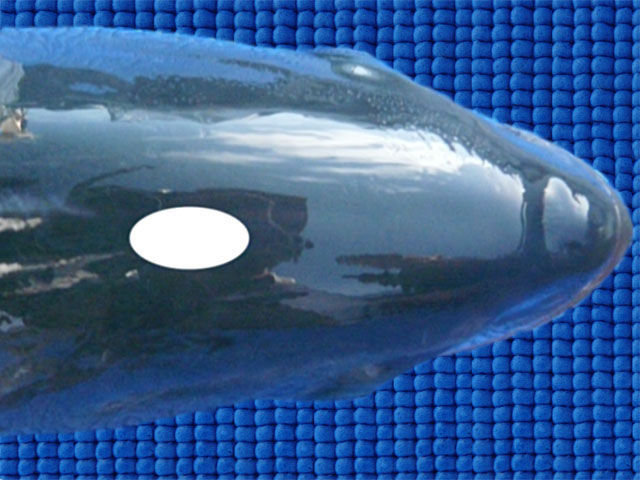
The brain of a fish is much smaller and much farther back than most people think. On almost every pelagic and reef species we shoot, the brain sits behind the eye, slightly above the imaginary line you would draw through the middle of the eye. It is roughly the size of a kidney bean on a twenty-pound yellowtail. Not big. Not forgiving.
Directly behind and above the brain is the spinal cord, which runs along the top of the fish from the base of the skull back to the tail. The first inch or two of spine right behind the skull is the sweet spot. Hit anywhere along this section and you sever the nervous system. The target is not a dot. It is a short, dense strip of nervous tissue tucked just under the top of the fish's back, above the gill plate.
This is why aiming for the eye itself is usually wrong. The eye is a landmark, not a target. Aim behind the eye, with an angle that sends the shaft into the brain and through the spine beyond it. That is a stone shot every time.
Shot Placement by Species
Yellowtail and Kingfish
The classic stone on a yellowtail is the butterfly, also called the gill-plate shot. Broadside fish. Aim just behind the eye and slightly above it, where the top of the gill plate meets the shoulder. Angle the shaft slightly down and forward so the tip drives through the brain, through the upper spine, and ideally out the opposite gill plate. On bigger fish this is where a slip tip really pays off, because you get that full pass-through commit and both gill plates are toggled. A properly placed butterfly shot drops a twenty-pound yellowtail like someone pulled the plug. No run, no dive, no head shake.
White Sea Bass
White sea bass are similar to yellowtail in target placement but the fish is a little more forward-weighted and the head is chunkier. Aim behind the eye, slightly above the lateral line, and angle the shaft forward into the brain. A shot too far back misses the brain and catches spine only, which will usually still stone the fish but leaves a larger blood channel through meat you want to keep clean. The head shot from broadside is ideal. White sea bass will also come in curious and give you a slightly quartering angle; adjust your aim so the shaft still lines up to run through the brain from whatever angle you have.
Calico Bass
Calicos live and die by structure. A running calico is a lost calico. The shot you want is the shoulder shot, into the top corner of the gill plate. You are not trying for a clean head shot on a four-pound bass. You are trying to pin through the spine at the base of the skull and into the shoulder so the fish cannot flare gills and wedge. A shot angled slightly down from a broadside fish, entering right above the pectoral fin where the gill plate meets the body, gets you there. On a kelp bass, a running shot in the gut is a lost fish 80 percent of the time.
Halibut
Halibut are the species where divers lose the most fish to bad placement. The body is almost all muscle and flop. Shoot a halibut through the body and it will spin, roll, thrash, and tear itself off the shaft or shred the flopper hole wide open. The answer is simple: on a halibut, never shoot the body. Approach from behind so the fish does not spook, come up and over the top of its head, and shoot straight down through the skull. The target is a small zone centered between and slightly behind the eyes. That is the brain. A downward shot through the brain pins the fish to the sand and stones it instantly. On bigger halibut, a slip tip with a heavy shaft gives you the penetration you need through that dense skull.
Tuna
Tuna are the hardest fish to stone, full stop. They are built like torpedoes with dense bone plates around the brain, a high-tension muscle wall, and an aerobic engine that will not quit until the central nervous system is destroyed. The shot you want is the butterfly, gill-plate to gill-plate, with enough gun and shaft to punch all the way through. Aim behind and above the eye, angled slightly down and forward. On a big yellowfin or bluefin, anything less than a three-band gun with a heavy shaft and a slip tip is probably not going to commit the fish. Body shots on tuna are the worst of all worlds. They run, they die slowly, they sound, and they attract every predator within a thousand yards.
Grouper
Groupers are the wedging masters. A conscious grouper will be inside the reef in a heartbeat and you will never pry it out. The stone on a grouper has to be fast and it has to be first-shot. Aim for the brain, behind and above the eye, angling the shaft to drive through the skull and into the upper spine. Close the distance before you shoot. A stoned grouper at six feet is a landed grouper. A stung grouper at fifteen feet is a grouper permanently installed in a rock hole. On larger tropical groupers the skull is thick; heavy shaft, slip tip, and do not take marginal angles.
Lingcod
Lingcod have long bodies and a head that is mostly mouth. The brain sits well back from the eyes, tucked down at the base of the skull where the head meets the body. The shot you want is at the back of the head, right where the skull ends and the spine begins, angled slightly down. This severs the spine above the brain and stones the fish. A body shot on a ling almost always results in a run for a crack or a ledge, where they lock up with those gill flares and make your life hard. Broadside shots at the base of the skull are the answer.
Technique: Making the Shot
A stone shot starts well before the trigger pull. It starts with waiting for the right angle. The right angle on almost every fish is broadside, not head-on. Head-on shots present a small, forward-moving target with layers of skull bone in front of the brain. Broadside shots give you the widest possible window into the brain and the spine behind it.
Aim behind the eye on almost every species. The eye is a landmark. The brain is behind it and slightly above. Picture the shaft path. Imagine the shaft entering just behind the eye, driving through the brain, exiting through or near the opposite gill plate, or pinning the spine just above. If you can picture that path before you pull the trigger, you are on the shot. If you cannot, wait.
Never aim for the middle of the body. A gut shot destroys the meat you came to get, lets the fish run full speed until it bleeds out, and maximizes the chance of losing the fish in structure or to predators. If the only shot available is a body shot, the better decision is almost always to pass and wait.
The angle of the shot matters as much as the point of aim. A downward angled shot into the top of the gill plate reaches the brain and spine even on a fish that is slightly quartering toward you. A shot from directly above, as on halibut, aims for the top of the skull and drives straight down into the brain. Think of every shot as a line, not a point.
Practice on land. Ice-shot targets, foam blocks, cardboard with a dot drawn behind an imaginary eye, whatever you can rig. Shoot from distances that match your actual water distances. Most divers are shockingly inaccurate beyond eight feet and have no idea because they never measure. Know your gun's accuracy at five feet, at eight feet, at twelve feet. Know where it shoots high, where it shoots low, where the shaft starts to flutter. A stone shot is an accuracy shot and accuracy comes from repetition.
Aim small, miss small. When you line up the shot, do not aim at the fish. Aim at a scale. Aim at a mark just behind the eye. Pick a spot the size of a quarter and put the shaft on it. Divers who aim small stone fish. Divers who aim at the fish as a whole shoot fish in the body.
Close range helps. The closer you are when you pull the trigger, the higher your stone rate. At three feet you can place a shaft inside a dime. At fifteen feet you are hoping. Spend your energy on the stalk, not on the long shot. A fish that comes to seven feet and gives you a broadside window is a fish you will stone. A fish that stays at fourteen feet and quarters away is a pass.
Why a Stone Shot Beats a Running Shot, Every Time
A running shot is any shot that hits the fish without disabling the central nervous system. Flank shots, gut shots, tail shots, shoulder shots that miss the spine. The fish lights up and takes off. Everything that happens next is worse than a stone.
The fish goes into structure. Reef fish, calicos, groupers, lingcod, sheephead, all of them have a single instinctive response to being shot, which is to get inside the closest rock and lock up. Extraction is slow, damaging to your gear, damaging to the reef, and often ends with you going home empty-handed. A stoned fish never heads for structure because it never heads anywhere.
Sharks home in on the vibrations. Every wounded fish broadcasts a distress signal. If you dive anywhere with white sharks, sevengills, bull sharks, or tigers, a running fish is a sharp invitation. A stoned fish makes no signal. In Southern California waters where white sharks are part of the daily reality, shot quality is a direct input into personal safety.
Meat is cleaner. Less lactic acid, less adrenaline, less bruising, less bloodshot flesh. If you have ever wondered why the same species tastes one way at a good restaurant and another way out of your own cooler, the answer is almost always how the fish died.
It is humane. A clean kill is an ethical kill. A ten-minute fight with a gut-shot fish is not.
You lose less gear. Every experienced diver has paid the tuition on this one: a bent shaft, a pulled slip tip, a severed shooting line, a lost flopper. Stone shots protect your wallet.
Gear That Helps You Stone Fish
Gear is not a substitute for shot placement, but the right gear gives the shot placement somewhere to land.
A heavy shaft drives penetration. Thin shafts bend, flutter, and lose energy on impact. A seven or seven-point-five millimeter shaft pushes through skull, bone, and gill plates where a lighter shaft stalls. For any fish over twenty pounds, heavier is almost always better.
A slip tip is the piece of gear that most consistently turns marginal stone shots into landed fish. When the tip passes through both gill plates and toggles behind the opposite plate, you have both halves of the fish locked onto the shooting line. Even if the stone is not perfect, the fish cannot run free.
A three-band gun for bigger fish. Two bands will stone a fifteen-pound yellowtail all day, but a forty-pound yellowtail, a tuna, or a big white sea bass requires more energy. The extra band drives the shaft deeper, flatter, and faster. Flatter shafts hit where you aim. Slow shafts curve, drop, and miss the small window you are trying to hit.
Match your gun to your fish. A seventy-five centimeter reef gun will not stone a twenty-pound yellowtail from ten feet. A hundred-and-fifty centimeter railgun is not the right tool for calicos at five feet in thick kelp. The right tool, correctly tuned, makes the shot easier.
Putting It All Together
The stone shot is the single skill that most separates beginning divers from experienced ones. It is also the skill that is most in your control. You cannot control the fish, the visibility, the current, or the weather. You can control where you aim and when you pull the trigger.
Build the habit on every dive. Wait for the broadside. Aim behind the eye. Picture the shaft path through the brain and spine. Close the distance first, shoot second. Practice on land so that underwater the shot is automatic. Match your gear to the species. Pass on bad angles even when the fish of a lifetime is sitting there quartering away. Another fish will come.
When you start stoning fish consistently, everything else about diving gets easier. Landing rates go up. Gear losses go down. Meat quality jumps. Shark interactions drop. You start dropping back into the water for the next fish instead of wrestling the last one out of a rock. The dive becomes calmer, cleaner, more efficient. That is the real reward of the stone shot.
It is also the most direct expression of respect for the fish. Clean kill, clean meat, no suffering, no waste. The stone shot is the whole reason we learn to hunt underwater instead of just poking fish.
Before your next trip, check live visibility, wind, and species-specific conditions at conditions.spearfactor.com.
Pictures: Yellowtail brain location Ikijime https://www.ikijime.com/fish/yellowtail-kingfish/

Comments