


Green Water That Still Dives Clean: Chlorophyll vs. Turbidity


Every diver knows the sinking feeling of pulling up to the coast and seeing green water. But here’s something the veterans have learned and the data now backs up: not all green water is bad water. Some of the greenest-looking days still deliver 30 feet of visibility — and there’s a way to tell the difference before you ever get wet. The trick is reading two numbers instead of one.
Two Numbers, Not One
When people say “green water,” they’re usually blending together two very different things:
Chlorophyll measures how much phytoplankton — microscopic marine plant life — is in the water. High chlorophyll means a bloom is on, and it tints the water green.
Turbidity measures how cloudy the water actually is: how many particles are suspended and scattering light. It’s what actually steals your visibility, and it’s usually reported in NTU (nephelometric turbidity units).
Here’s the key: those two don’t always move together. And when they split apart, the gap between them tells you what kind of green you’re dealing with.
The Tell: High Chlorophyll, Clean Water
When chlorophyll runs high but turbidity stays low, the green you’re seeing is mostly pigment and fine organic matter — fluorescence and “marine snow,” the drifting flecks of organic material — rather than a heavy load of light-blocking sediment. The water reads green from the surface, or from a satellite, but you can still see through it once you drop in.
A recent example: over the Fourth of July weekend, one central-California reading had chlorophyll elevated (around 2.0) while turbidity stayed clean (well under 0.5 NTU). That combination points to a fluorescence / marine-snow bloom rather than true sediment murk — and sure enough, divers reported roughly 30 feet of visibility outside the cove that day. Green on paper, perfectly diveable underneath.

When Green Really Does Mean Murk
The opposite pattern is the one to respect. When turbidity climbs — whether or not chlorophyll is high — the water is genuinely loaded with light-scattering particles. That’s the true murk, and it usually comes from:
River and creek runoff after rain, dumping sediment into the nearshore.
Swell and surge stirring the bottom and re-suspending sand and silt, especially at shallow, exposed spots.
A dense, decaying bloom that has moved past pigment into a thick particle soup.
On those days the green is opaque, and no amount of depth access saves the top of the water column. Turbidity is the number that actually tracks with “I can’t see my fins.”
Why This Matters More in Summer
Central California makes this especially tricky. Summer there is cold, calm, and productive — long days and upwelled nutrients feed heavy blooms that sit undisturbed near the surface, so chlorophyll spikes. But a chlorophyll spike alone won’t tell you whether you’ll get pea soup or a perfectly diveable green. The bloom also tends to stack in the top ~20 feet, so a spot with depth access can drop you below the worst of it. Reading turbidity alongside chlorophyll — and knowing your spot’s typical dive depth — is how you separate a wasted drive from a great day.
The Northern Sea of Cortez: Green as a Baseline
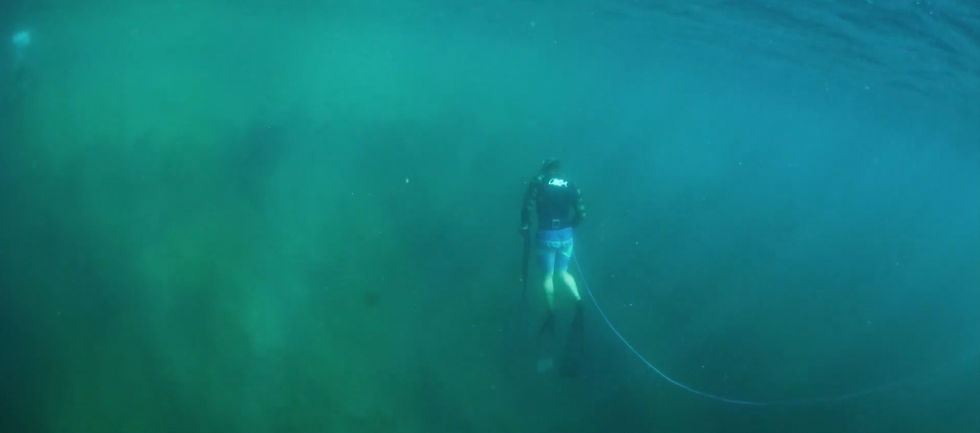
If you have dived the northern Sea of Cortez, you already know the water almost always carries a green tint — even on calm, beautiful days when the fishing is on. It rarely turns the deep tropical blue you get farther south around La Paz or Cabo Pulmo, and that throws off divers who expect gin-clear gulf water.
That green is a feature of one of the most productive bodies of water on the planet. The northern gulf is shallow, swept by enormous tides, and fed by nutrient-rich water that supports a near-constant plankton base. High productivity means high chlorophyll — and high chlorophyll means green. It is the same signal we have been describing all along: color driven by life in the water, not sediment suspended in it.
For divers, the practical upshot is a familiar one. Green Cortez water is often perfectly workable — you can make out your buddy, your line, and structure well enough to hunt, even while the whole scene reads emerald instead of blue. The same productivity that greens the water is what packs the northern gulf with pargo, cabrilla, and gulf grouper. Learn to read that green as alive and feeding rather than blown out, and you will dive days that other people write off.
How to Use It
Don’t cancel on chlorophyll alone. A green forecast isn’t automatically a blown-out one.
Let turbidity break the tie. High chlorophyll with low turbidity is often a green light, especially at deeper or more exposed spots. High turbidity is the real red flag.
Factor in recent rain and swell. Both push turbidity up regardless of the bloom.
Use depth. When a surface bloom is fluorescence and marine snow, dropping below it frequently buys you clearer water.
The Bottom Line
Green water gets a bad reputation it doesn’t always deserve. Next time the surface looks like pea soup, look past the color: if the water is tinted but not truly turbid, you may be in for a far better dive than the view from the parking lot suggests.
Photo credits: Giant kelp forest (Macrocystis pyrifera) by BravoGonzalo (CC BY-SA 4.0, via Wikimedia Commons); phytoplankton bloom in the Barents Sea by Jeff Schmaltz, NASA MODIS Land Rapid Response Team (public domain).


What are your go-to resources for reading these conditions? I've loved tempbreak, but can't remember the last time chloro was actually an option. I've been getting more and more into tracking/following conditions more closely, especially with something like Claude to collate and analyze multiple sources for site specific analysis, but not really sure where to look beyone basic swell/wind/weather conditions.