


How to Spear Yellowtail in California: Tactics, Timing, and Where to Find Them

Why Yellowtail Are California's Ultimate Spearfishing Target

If you asked a hundred California divers to name their favorite fish to hunt, yellowtail would be at or near the top of every list. There is a reason for that. California yellowtail (Seriola dorsalis) combine everything that makes spearfishing addictive — they are fast, powerful, wary, and absolutely delicious. Landing one on a breath hold is a genuine achievement, whether it is your first or your fiftieth.
Yellowtail are pelagic predators that patrol the edges of kelp forests, rocky reefs, and offshore pinnacles in packs. They are constantly moving, constantly feeding, and constantly aware of everything around them. They will circle a diver just out of range, testing your patience and your breath hold, and then disappear the moment you make a wrong move. When you finally connect, the fight is immediate and violent — a hard run toward the nearest structure, a test of your gear and your ability to manage a fish that does not want to stop moving.
And then there is the table. Fresh yellowtail sashimi from a fish you speared an hour ago is one of the finest things you will ever eat. Grilled, pan-seared, or served raw, it is world-class fish by any standard.
Understanding the California Yellowtail
Biology and Behavior
California yellowtail are members of the jack family (Carangidae) and are closely related to amberjack found in other parts of the world. They are built for speed — torpedo-shaped bodies, powerful forked tails, and a distinctive bright yellow stripe running from eye to tail that gives them their name. Adults commonly range from 10 to 30 pounds, with trophy fish exceeding 40 pounds. The California record is over 60 pounds.
Yellowtail are schooling fish, but the schools vary in size and behavior depending on conditions. You might encounter a massive bait ball surrounded by dozens of yellowtail in a feeding frenzy, or you might find a pair of large fish cruising slowly along a reef edge. Smaller fish tend to travel in larger schools and are less wary. The bigger fish — the ones over 25 pounds — are often in smaller groups of two to five and are significantly harder to approach.
They are warm-water fish. When ocean temperatures climb above 64 degrees, yellowtail become more active and move closer to shore. Below 60 degrees, they tend to push offshore or migrate south. This thermal preference drives their seasonality in California and determines when and where you will find them.
Yellowtail vs. White Sea Bass: Different Hunts Entirely
Divers new to California often lump yellowtail and white sea bass together as "the big two," but the hunts could not be more different. White sea bass are ambush fish — you wait in kelp, stay quiet, and hope one ghosts into range. Yellowtail are the opposite. You need to be active, aggressive with your positioning, and willing to work for every shot opportunity. White sea bass reward patience. Yellowtail reward athleticism and reading the water.
California Yellowtail Regulations
The regulations for yellowtail in California are straightforward:
Minimum size: 24 inches fork length. That is measured from the tip of the snout to the fork of the tail — not total length. This is an important distinction because yellowtail have long, pointed tail lobes. Fork length will always be shorter than total length.
Bag limit: 10 fish per day. There is no closed season — yellowtail can be taken year-round.
Spearfishing is a legal take method. Both spearguns and polespears are permitted. As with all California spearfishing, check for marine protected areas at your dive site. Some MPAs allow limited take while others prohibit it entirely.
When Yellowtail Show Up in California
The Seasonal Pattern
Yellowtail follow the warm water. The typical California season runs from late May through November, with peak action from June through September. Here is how the season generally unfolds:
May through June: The first yellowtail of the season start showing up as water temperatures push into the mid-60s. Fish begin appearing around the Channel Islands and along the San Diego coast. Early season fish are often hungry after a lean winter and can be aggressive.
July through August: Peak season. Water temperatures are at their warmest, baitfish are abundant, and yellowtail are stacked on structure from the Mexican border to Point Conception. This is when you will find the biggest schools and the most consistent action.
September through October: Still excellent. Water remains warm and the fish are fattening up before the fall cooldown. Some of the largest yellowtail of the year are taken in September and October when the big fish are feeding heavily.
November through December: The tail end of the season. As water temperatures drop below 64 degrees, yellowtail start pulling away from shore and heading south. You can still find fish on warm-water years, but the window narrows.
Water Temperature Is Everything
More than any other factor, water temperature dictates yellowtail behavior. When you are planning a yellowtail dive, check the sea surface temperature at your target spot. If the water is 66 degrees or warmer, you are in the zone. At 64 to 66, fish may be present but less active. Below 62, your odds drop significantly.
The SpearFactor Fish and Dive Conditions tool tracks water temperature at dive spots across California and can help you time your sessions. Yellowtail is one of the species the tool scores, so you can check the fish probability for your specific location.
Where to Find Yellowtail in California
San Diego County
San Diego is ground zero for yellowtail in California. The warm water reaches here first, the season lasts longest, and the combination of kelp beds, rocky reefs, and offshore structure creates ideal habitat.
La Jolla: The kelp beds from La Jolla Cove south to Bird Rock are classic yellowtail territory. Fish patrol the outer edges of the kelp, especially where the canopy gives way to open water over reef structure. The submarine canyon at La Jolla Shores creates upwelling that attracts baitfish, which in turn draws yellowtail. Be aware that La Jolla has multiple marine protected areas, including the San Diego-La Jolla Ecological Reserve and the Matlahuayl State Marine Reserve. Spearfishing is prohibited in these zones. Know the exact boundaries before you dive — they are not always obvious from the water, and a citation is not worth the fish.
Point Loma: The kelp beds off Point Loma are some of the most productive yellowtail grounds in the state. Fish cruise the edges and channels in the kelp, and the deeper structure offshore holds larger fish later in the season.
Coronado Islands (Mexico): Technically across the border, but many San Diego divers make the run to the Coronados. The islands hold yellowtail from spring through fall and the fish tend to be larger than what you find inshore. You need a Mexican fishing license.

Dale with a Coronado Islands yellowtail.
Orange County
Dana Point and Salt Creek: The reefs off Dana Point hold yellowtail when the water warms up, typically starting in June. The rocky structure and kelp provide hunting grounds, and fish move through the area following baitfish schools.
Laguna Beach: The marine protected areas along Laguna limit where you can take fish, but the areas open to spearfishing hold yellowtail on reefs and rocky points. Crystal Cove and the areas south of it are productive.
Channel Islands
The Channel Islands are the premier yellowtail destination in California. The islands offer clean water, abundant structure, and fish that see less pressure than mainland spots.
Santa Catalina Island: The most accessible of the Channel Islands, with yellowtail stacking up along the back side (north shore) in summer. The east end around Church Rock and the west end near Eagle Reef are standout spots. Catalina yellowtail can be large — fish over 30 pounds are taken regularly.
San Clemente Island: Deeper, more remote, and home to some of the biggest yellowtail in the state. The island's steep walls and pinnacles create ideal ambush structure. Access is limited by Navy operations but when conditions align, San Clemente is hard to beat.
Santa Barbara Island and Santa Cruz Island: Both islands hold yellowtail during the warmer months. Santa Barbara Island's exposed position in warm currents makes it a consistent producer, and Santa Cruz has extensive kelp and reef structure along its southern shore.
Central California
Yellowtail are less common north of Point Conception, but during warm-water years they show up in Morro Bay, along the Big Sur coast, and occasionally as far north as Monterey. Do not plan a trip specifically for yellowtail in Central California, but if you are diving there during a warm summer and the water temperature is up, keep your eyes open.
How to Hunt Yellowtail
Reading the Water
Before you even get in, read the surface. Look for birds working — diving pelicans and terns are following baitfish, and yellowtail are often right below them. Boils on the surface (baitfish being pushed up by predators below) are an obvious sign. Current lines, temperature breaks, and floating kelp paddies offshore all concentrate bait and attract yellowtail.
The Approach
Yellowtail are curious but cautious. When a school moves through, resist the urge to chase them. Chasing yellowtail is a losing game — they are faster than you, and pursuit triggers their flight response. Instead, use these techniques:
The ambush. Position yourself on a reef edge, pinnacle top, or kelp line where you have seen fish moving through. Get to your depth, settle in, and wait. Yellowtail often circle back through the same zones, and a motionless diver on the bottom is far less threatening than one thrashing at the surface.
The blacksmith. This is one of the most reliable techniques near reef edges and pinnacles, especially around La Jolla and other Southern California reefs. Look for schools of blacksmith — the small, dark perch that hover in dense clouds along structure. Yellowtail feed on blacksmith and are almost always nearby when the blacksmith are present. When you locate a school, position yourself on the edge of the blacksmith at mid-water column, or drop to the bottom directly below them. Stay still and wait. If yellowtail are in the area, they will come in curiously to investigate. The blacksmith act as both a food source and a visual indicator — if you are not seeing blacksmith on a reef, the yellowtail probably are not there either.
The flasher. A flasher — a spinning, reflective device on a weighted line — mimics a wounded baitfish. Drop it near structure where yellowtail are cruising and hang back 10 to 15 feet away. The flash and vibration draw curious yellowtail in close, often bringing them within range when they would otherwise stay distant.
The drop. When you spot yellowtail from the surface, do not dive directly at them. Instead, dive down to their depth about 30 to 40 feet ahead of their travel direction. Settle on the bottom or near structure and let them come to you. If they are moving along a reef line, get ahead of them and wait.
Shot Placement
Yellowtail are strong, muscular fish with tough scales and dense flesh. A poorly placed shot will result in a lost fish — they have the power to tear off a spear tip or pull free from a marginal hit.
The money shot is through the spine, just behind the gill plate. This is the thickest, most structural part of the fish. A clean spine shot drops them immediately and prevents the fish from running into structure where it can tangle your line or break your shaft.
Avoid the tail section. The meat thins out quickly behind the dorsal fin, and a shot here gives the fish maximum leverage to pull free. Also avoid shooting at a fish that is facing you head-on — the frontal profile is narrow and the shot can glance off the skull.
Wait for a broadside presentation. Patience here saves you fish. Let the yellowtail turn and give you a full broadside view before pulling the trigger. That extra second of patience is the difference between a clean kill and a lost fish.
After the Shot
A speared yellowtail will run — hard. Be prepared for an immediate, powerful surge toward the nearest structure. If you are using a reel gun, keep tension on the line but let it run. If you are using a float line, let the float do its job and follow the fish from the surface.
Do not try to horse a green yellowtail to you. Let it tire against the float or the drag on your reel. When the runs get shorter and the fish starts circling, work it in carefully. Grab it behind the gill plate and dispatch it quickly.
Gear for Yellowtail
Speargun
Yellowtail require more gun than halibut or most reef fish. A 110 to 130 cm speargun with double 5/8 inch bands is the standard setup. You need range because yellowtail rarely let you get closer than 8 to 12 feet, and you need penetration because they are thick, dense fish.
A roller gun in the 100 to 120 cm range is an excellent alternative — rollers deliver more power from a shorter platform, which is easier to maneuver in kelp.
Use a slip tip. Yellowtail pull hard enough to back out a standard flopper, especially on a marginal hit. A slip tip with a cable or dyneema keeps the toggle locked behind the spine even when the fish is surging.
Float Line and Float
A float line setup is the most common and arguably the best configuration for yellowtail. A 50 to 75 foot float line connected to a rated dive float gives the fish something to fight against while keeping your hands free. The float also marks the fish's position if it runs into structure.
For big yellowtail (25+ pounds), use a float rated for at least 30 pounds of lift. An undersized float will get dragged under and becomes useless.
Flasher
A flasher is not mandatory, but it significantly increases your encounters. A simple setup — reflective mylar strips on a swivel, dropped to mid-water on a weighted line — draws yellowtail from surprisingly far away. Commercial flashers work well, or you can make your own with strips of reflective tape and a snap swivel.
Cleaning and Cooking Yellowtail
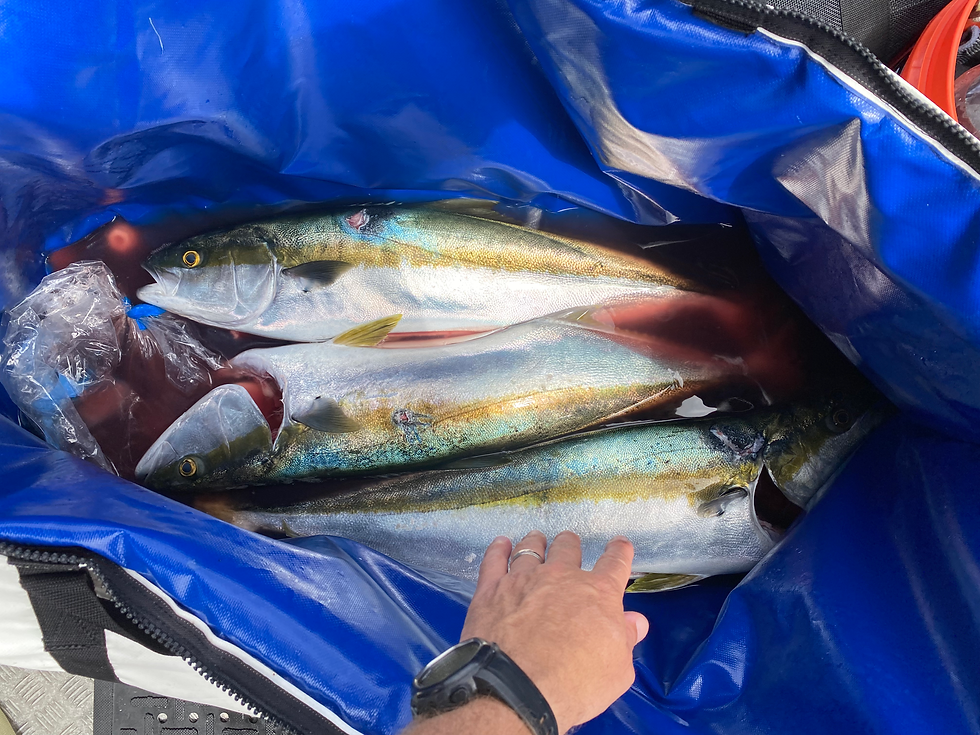
Yellowtail is one of the premier eating fish in the Pacific. The flesh is rich, buttery, and slightly pink with a clean flavor that works raw or cooked. Here is how to make the most of your catch.
Bleeding and Icing
This is critical for yellowtail. As soon as you land the fish, cut one of the gill arches and let it bleed out in the water. Blood left in the meat darkens the flesh and gives it a stronger flavor. Once bled, get the fish on ice immediately. Yellowtail flesh deteriorates fast in the heat — a fish left on a warm boat deck will taste noticeably worse than one properly iced within minutes of the kill.
Sashimi
The single best way to eat fresh yellowtail. Fillet the fish, remove the skin, and slice against the grain into quarter-inch pieces. Serve with soy sauce, fresh wasabi, and pickled ginger. Yellowtail sashimi from a fish speared hours ago is as good as it gets — clean, buttery, melt-in-your-mouth texture that rivals anything you will find in a high-end sushi restaurant.
Grilled Collar
The collar — the section behind the head and around the pectoral fin — is the most underrated cut on a yellowtail. Season with salt, brush with a little oil, and grill over high heat until the skin is crispy and the meat is just cooked through. The collar has more fat than the loin, which makes it incredibly rich and flavorful. In Japan, hamachi kama (grilled yellowtail collar) is considered a delicacy.
Pan-Seared with Ponzu
Skin-on fillets, scored lightly on the skin side, seared in a screaming hot pan with a little oil. Cook 2 to 3 minutes skin-side down until crispy, flip for 30 seconds, then plate with a drizzle of ponzu sauce and sliced scallions. The crispy skin and rich flesh with the citrus punch of ponzu is outstanding.
The California Reality
Yellowtail are the fish that keep California divers coming back season after season. The combination of challenge, athleticism, and reward makes them uniquely satisfying to hunt. Every encounter is different — the water, the bait, the mood of the fish — and even experienced divers never stop learning new ways to read the situation and get closer.
The season is approaching. Start watching water temperatures, keep your gear maintained, and when those first reports of yellowtail start coming in from San Diego and the Channel Islands, be ready to go. The fish will not wait.
Frequently Asked Questions
What size speargun do I need for yellowtail?
A 110 to 130 cm speargun with double 5/8-inch bands is the standard yellowtail setup. You need range because yellowtail rarely let you closer than 8 to 12 feet, and you need penetration to get through their thick, dense flesh. A roller gun in the 100 to 120 cm range is an excellent alternative that delivers more power from a shorter platform.
How deep do you dive for yellowtail in California?
Most yellowtail encounters happen between 20 and 60 feet. The fish patrol reef edges, pinnacle tops, and kelp canopy at mid-water depths. You do not always need to be on the bottom — positioning yourself at the thermocline or near schools of blacksmith at mid-column is often more effective than dropping all the way to the sand.
What water temperature do yellowtail prefer in California?
Yellowtail become active and move inshore when water temperatures reach the low-to-mid 60s Fahrenheit. The ideal range is 66 degrees and above. At 64 to 66 degrees, fish may be present but less aggressive. Below 62 degrees, your chances of encountering yellowtail drop significantly and the fish tend to push offshore or migrate south.
Do I need a slip tip for yellowtail?
A slip tip is strongly recommended. Yellowtail fight hard enough to back out a standard flopper tip, especially on marginal hits through softer tissue. A slip tip with cable or dyneema keeps the toggle locked behind the spine even during sustained surges. This is particularly important for fish over 20 pounds that will make long, powerful runs toward structure.
What is the bag limit for yellowtail in California?
The daily bag limit is 10 yellowtail per day with a minimum size of 24 inches fork length. Fork length is measured from the tip of the snout to the fork of the tail, not total length. There is no closed season — yellowtail can legally be taken year-round in California, though they are primarily available from late May through November.
Photo: Dale with a Coronado Islands yellowtail, courtesy of SpearFactor.


Comments