


Roller Spearguns Explained: Why Divers Are Switching and Who Should Buy One


Walk around a California boat launch these days and you will notice more roller spearguns than ever. A few years back they were a niche item — something you saw in bluewater tuna videos or on the backs of custom builders. Now they are mainstream. Roller guns deliver more power in a shorter package, shoot quieter, and load with less effort once you get the hang of them. But there is also a lot of confusion about what a roller actually is, how the different designs work, and which one is right for which diver. This guide clears that up.
What a Roller Speargun Actually Is
On a standard band speargun, the bands run from the muzzle directly back to the shaft's wishbone. The bands only stretch along the section in front of the muzzle, and the energy they deliver is limited by how much length you have in that space.
A roller speargun adds pulleys (the "rollers") somewhere on the gun to redirect the band path. The band wraps around the pulleys and stretches along more of the gun's total length than it could on a standard design. More band stretch equals more stored energy. The same gun length delivers a noticeably harder shot, or equivalent power in a shorter package.

The Three Roller Designs
There are three main roller configurations. They are genuinely different from one another — different band paths, different load mechanics, and different use cases. The terminology gets muddled online, so here is the clean version.
Standard Roller (Single Roller / Front Roller)
The most common design. Pulleys are mounted at the MUZZLE. The band wraps around the muzzle pulleys, travels back along the top or bottom of the gun barrel, and anchors near the handle. When you load the gun, you pull the wishbone forward toward the muzzle — the band is pulled through the muzzle pulley, which stretches the section of band running back along the gun. Released, the band snaps through the pulley and drives the shaft forward.
Standard rollers are the easiest to understand, the easiest to service, and the most widely available. Most production rollers from TAG, Neptonics, Brian at Unklelearuhow, and Andre use this layout. If someone says "roller speargun" without qualification, this is what they mean.
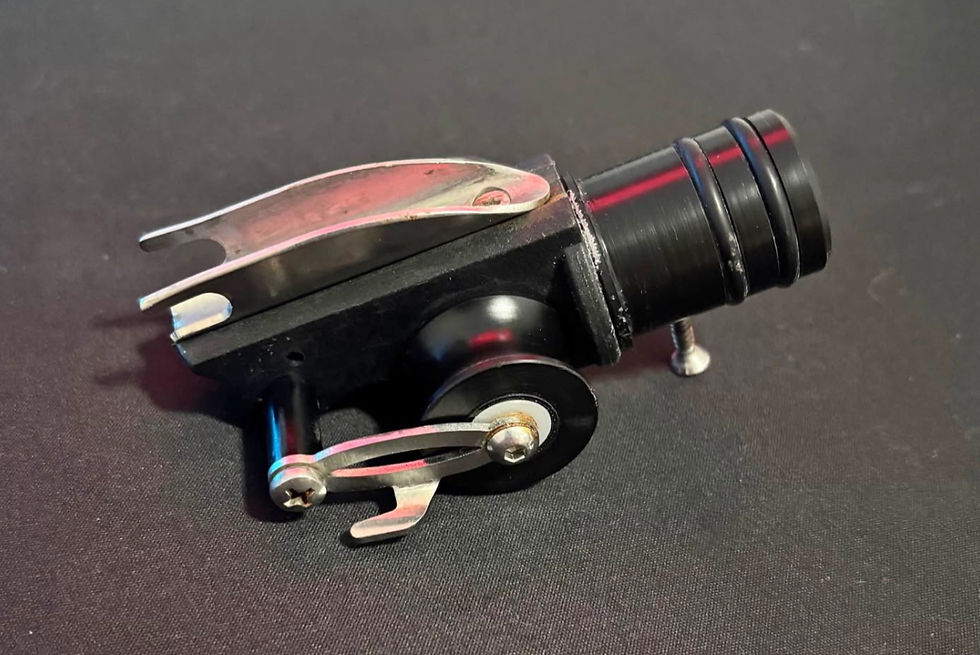
Inverted Roller (Invert / Rear Roller)
Pulleys are mounted at the HANDLE / rear of the gun — the opposite end from a standard roller. The band anchors at the muzzle and wraps around the rear pulleys. Inverted rollers deliver the most energy per gun length of any speargun design and are the roller spearguns of choice for serious bluewater hunters chasing tuna, wahoo, and big pelagics.
Fans of the invert design argue it is quieter at release (less band slap against the barrel), better balanced (weight is biased back toward the handle rather than out at the muzzle), and easier to point and track because the muzzle is lighter. Detractors argue it is more complicated to rig and harder to service. Both are fair. Builders making invert rollers include Unkleleaeruhow, Hotrod, and TAG Spearguns (the TAG Pack Roller is an invert). Some Wong and Andre custom guns are also built as inverts.
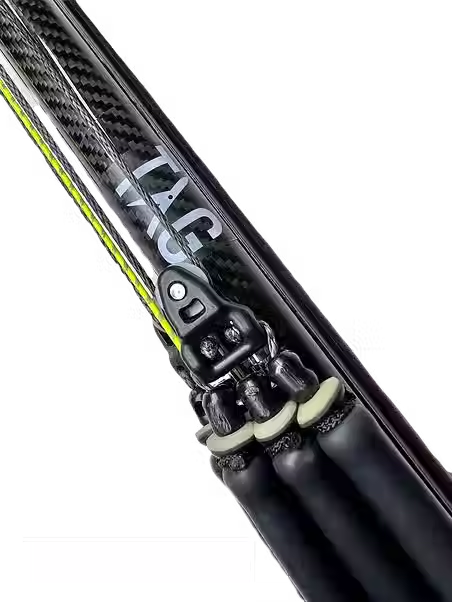
Double Roller

Two sets of rollers at the muzzle. The two bands wrap around both sets of pulleys, which means it effectively double the power of a single roller.
The tradeoffs are real. Double rollers have more complex band paths and loading them can require a specific order, and if you do it wrong, you have to start all over again, which can be very frustrating. You also typically load them in multiple stages to manage the heavier band tension. They are not a first gun, not a casual-diver gun, and not a kelp-forest gun. But for the right hunter on the right trip, a double roller is an incredible diverse weapon to have on you, whether you're on the reef or in the blue water.
Builders making double rollers include TAG Spearguns, Hatch Custom, Andre Spearguns, and a handful of other premium custom shops.
The Real Advantages
More power in a shorter gun. A 100 cm roller can shoot with the power of a 120-130 cm standard band gun. For divers who want bluewater-level energy but need to maneuver in kelp or on reef, this is the main selling point. A shorter gun tracks fast fish better, swings easier in tight structure, and fits a dive bag.
Quieter. Rollers put less band slap on release than a comparably-powered double-banded standard gun. On pressure-shy species like white sea bass, every decibel matters. A roller is not silent, but it is noticeably quieter than a standard double-band gun firing at similar energy.
Less recoil. Energy transfers more smoothly because the band is pulling the shaft through a longer portion of its stretch cycle, rather than slamming through a short stroke. This makes rollers more forgiving on long shots and less likely to throw your sight picture off.
Easier to load (with practice). Rollers load in stages. Instead of one brutal stretch on a standard double band, you make several smaller band pulls that each add tension. For divers with shoulder issues or anyone who wants to load at depth with less effort, rollers are kinder on the body. Double rollers in particular benefit from staged loading.
The Real Downsides
More complexity, more failure points. Pulleys, track guides, extra band wishbones — more parts mean more things that can go wrong. Rollers also need more precise tuning. Band length, pulley alignment, and shaft tracking all have to be dialed in for the gun to shoot straight. A misaligned pulley or a worn wishbone will send your shots wide.
Harder to service in the field. A broken band on a standard gun is a five-minute fix with a spare. A broken band on a roller might require rethreading pulleys and re-tensioning. Double rollers are the worst for field service. If you are a day-trip diver who does not want to fuss with gear, a standard band gun is simpler.
Higher cost. Entry-level rollers start around $600-$800. Mid-range wood or aluminum rollers run $900-$1400. Double rollers and premium custom inverts exceed $2000. A comparable standard band gun costs less at every tier.
Learning curve on the load. Until you have loaded a few hundred times, rollers feel awkward. Band placement, pulley wrap direction, and wishbone positioning all take practice. Most divers get past this in a season, but the first month or two is frustrating, especially with inverted rollers where the load direction is backwards from what most divers are used to.
Which Roller Should You Buy?
Standard roller: best entry into the roller category. Proven layout, widely available, easiest to service. Works for mid-range bluewater and serious reef hunting. If you are buying your first roller, start here.
Inverted roller: think of the difference between a standard recurve bow and a compound bow. More powerful for its size than any other combination, this gun is capable of doing it all. For divers who want quieter release, better balance, and a lighter muzzle for tracking. The learning curve is real because the load direction is reversed. Good choice for experienced roller owners who want to try something different, or for divers who prioritize balance over raw simplicity.
Double roller: all around powerful gun. These guns are very diverse and can handle just about anything. They are just a little more complicated to manage in the water, especially loading.

A Note on DIY Conversions
Some divers convert standard guns into rollers using aftermarket pulley kits. This can work well on well-built aluminum or wood guns, but it is not a casual project. The muzzle (or handle, for an invert) has to accept a pulley without compromising structural integrity, and the opposing anchor has to handle the redirected load. If you are comfortable with speargun mods, a conversion can save money. If you are not, buy a purpose-built roller from a reputable shop.
The Bottom Line
Rollers are a legitimate performance upgrade for divers who hunt the kind of fish that justify the extra complexity. They are not a first-gun choice, and they are not universally better than a standard band gun. But if you know what you want — maximum shot energy in a manageable package, a quieter release, or pure bluewater firepower — one of the three roller designs delivers. Standard for most, invert for the balance-and-quietness crowd, double for serious bluewater. Pick the one that matches your diving.
Check dive conditions before taking any new gun out for the first time. For free California-focused forecasts, visit conditions.spearfactor.com.
Never dive alone. Always use one-up-one-down buddy protocol. For more on freediving safety, visit freedivingsafety.com.
Note: Pictures by Cameron at TAG spearguns and my own guns.

Comments