


Duck Dive Technique: How to Descend Quietly and Efficiently

Every dive starts the same way: you are floating flat on the surface, breathing up, scanning the water. Then you spot something — a flicker of movement in the kelp, a shadow working the edge of a reef, the back of a fish cruising just below. The next two seconds decide the entire dive. If your transition from surface swimmer to descending diver is quiet and controlled, the fish stays where it is and you get a shot. If that transition is loud, splashy, or inefficient, the fish is gone before your head clears the surface, and you have burned oxygen you will miss on the bottom.
That transition is the duck dive. It is the single most repeated movement in spearfishing, and it is also one of the most commonly butchered. A bad duck dive is loud enough to push fish 30 yards before you are even below the surface. A good duck dive is silent, streamlined, and gets you pointed down with no wasted motion. This guide breaks down the mechanics step by step, the common mistakes divers make, the variations for different situations, and how to build technique that holds up as you push into deeper water.

What a Duck Dive Actually Is
A duck dive is the method of transitioning from a horizontal surface swim into a vertical descent. You start flat on the water, face down, snorkel in, gun in hand. You finish pointed straight down, arms along your body, fins submerged, kicking toward the bottom. That transition happens in roughly two seconds. Everything that decides how the rest of the dive goes — your angle of descent, your speed off the surface, the noise you make, how much oxygen you burn in the first five meters — is determined by what you do in those two seconds.
The duck dive is named after the way a duck tips forward, rotates, and disappears headfirst in one smooth movement. That is the shape you are trying to copy. Not a jump, not a surface kick, not a sit-down-and-sink. A rotation that uses body weight and gravity instead of muscle and splash.
Why Technique Matters More Than You Think
The most common way newer divers blow a dive is not a bad shot or a missed stone. It is a noisy duck dive. Sound travels roughly four times faster through water than through air, and it carries further. A splashy entry — fins slapping the surface, legs kicking while still partly out of the water, hands pushing off — broadcasts your position in every direction. Fish do not need to see you to spook. They feel the pressure wave and hear the turbulence, and they slide out of the zone you were planning to dive into. By the time your head clears the surface chop, your target has already repositioned ten to thirty yards away.
The second reason technique matters is oxygen. Every unnecessary kick, every flailing arm, every second spent transitioning instead of descending costs you bottom time. A clean duck dive uses gravity to do most of the first few meters of work. Your legs lift up, they hang briefly out of the water, and their weight drives your body down without a single kick. That is free depth. A diver with a sloppy technique has to kick immediately to overcome their own buoyancy, which burns oxygen and creates noise at the same time.
The third reason is descent speed. A head-first, streamlined duck dive gets you to working depth faster than a feet-first sink or a diagonal slide. Faster descent means more time on the bottom, less surface-to-bottom exertion, and a shorter distance between your breath-up and the strike zone.

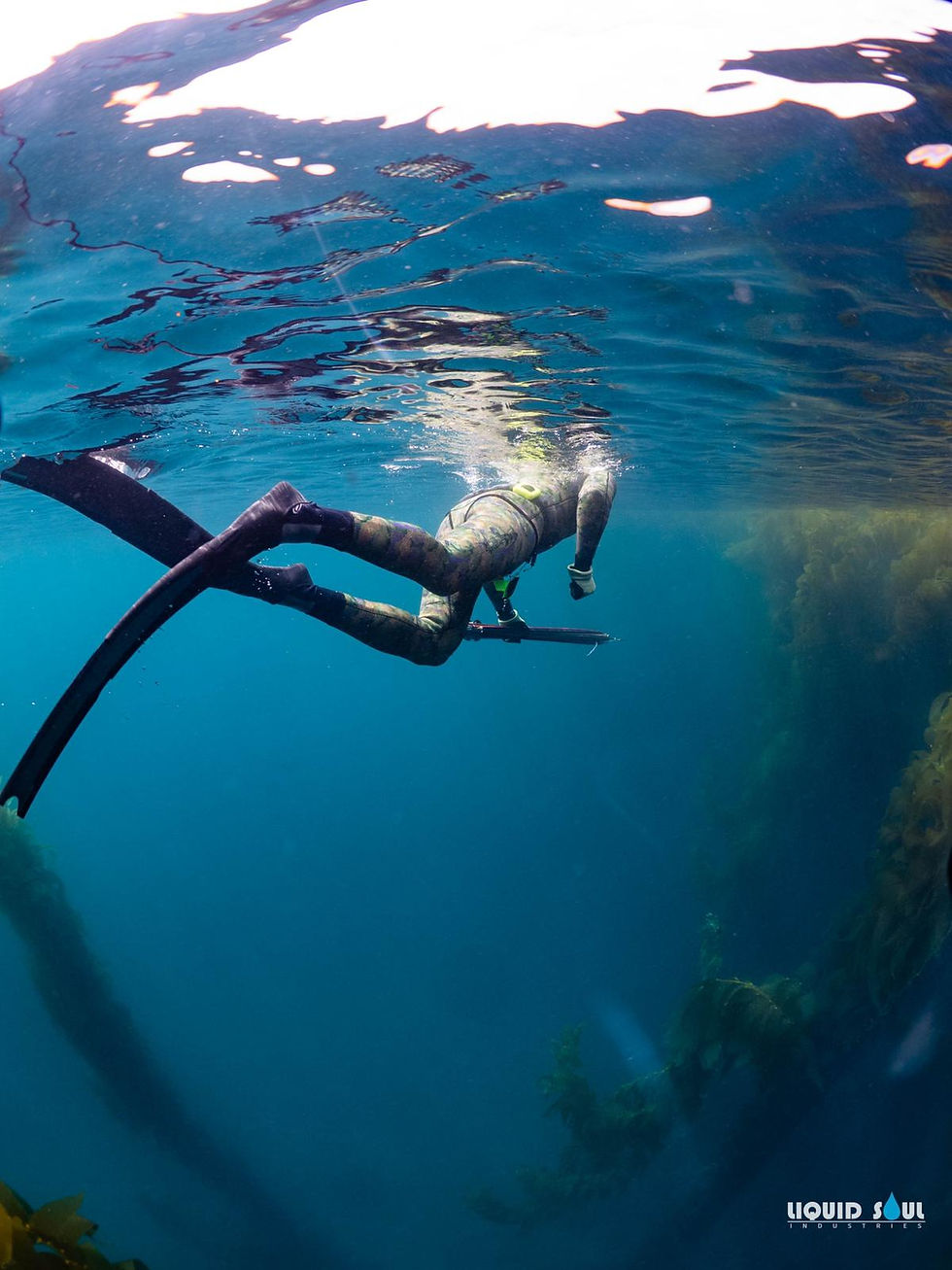
The vertical descent posture the duck dive sets up - body fully streamlined, head down, legs aligned with the body axis. The cleaner the duck dive, the faster you arrive in this position and the less energy you waste reaching depth.
The Mechanics, Step by Step
Walk through the movement slowly in your head before you ever do it in the water. Every phase has a purpose. Skipping a phase or rushing one is what creates noise and wasted effort.
Step 1: Float Horizontal at the Surface
Start flat. Face down, body extended, arms relaxed, gun held in one hand along your side. Your body should be as close to parallel to the surface as your suit and weighting allow. If your legs are sinking behind you, your weighting is probably too heavy. If your butt is riding high and your legs are flat but your chest is angled up, you are carrying tension somewhere. Relax into the float. The more horizontal and calm you are, the better the rotation will work.
Step 2: Take the Peak Breath
This is your final inhale before the dive. A full, relaxed breath that fills your lungs from diaphragm to upper chest. It should come at the end of a calm breathe-up, not jammed in at the last second. Once you have that breath, drop the snorkel from your mouth if you dive without it, or leave it in and let the water seal the tube as you descend. Do not exhale. Do not talk. Commit.
Step 3: Bend at the Waist, Drive Head Down
This is the actual duck dive initiation. Bend sharply at the waist and drive your head and upper body straight down toward the bottom. The motion is fast but not violent. Think of a hinge folding. Your chest, head, and arms go down together. Do not reach out in front of you like a swimmer pushing off a wall — that creates splash. Just fold. The gun hand tucks along your body as you bend.
Step 4: Lift the Legs Vertical
As your upper body is folding down, your legs come up. Do not kick them up. Lift them as one unit, straight and together, until they point at the sky. Because your upper body is already submerging, gravity does most of the work here. The legs rise naturally once the hinge is in place. The moment your legs are vertical, your body has formed a straight line from fins to fingertips, pointed at the bottom.
Step 5: The Pike — Legs Briefly Out of the Water
At the top of the rotation, your legs hang above the surface for a brief moment. This is the pike position. Your upper body is already a few feet underwater, pointed down. Your legs, fins, and sometimes your lower thighs are in the air. It looks and feels odd the first few times, but this position is where all the free depth comes from. Do not panic and kick here. Let the pike happen.
Step 6: Leg Weight Drives You Down
Your legs and fins are heavy in the air. That mass, unsupported by water, acts like a piston. Gravity pulls the legs down, which in turn drives your whole body deeper. You are descending without a single kick. This is the quietest, most efficient part of the entire dive. No splash, no muscle effort, just physics. If your technique is good, the pike phase alone gets you three to six feet below the surface.
Step 7: Begin Kicking Only When Fins Are Fully Submerged
Wait. Wait until your fins are entirely underwater. Not the foot pocket — the entire blade. Then, and only then, start your first kick. That first kick should be long, slow, and full range. A deep, deliberate stroke. Short choppy kicks at the start of a descent are one of the most common mistakes in the sport: they waste oxygen, create turbulence near the surface, and barely add speed. One big slow kick does more work than three short fast ones.
Key Technical Points
Never kick while any part of your fin is above water. This is the rule. Every splash is noise, and noise scatters fish. If you feel air on your blade during a kick, the kick came too early. Reset your timing on the next dive.
Arms tucked against the body for streamlining. On a one-handed duck dive, your gun hand stays along your thigh and your free hand tucks close to the other thigh. On a two-handed duck dive, both arms extend along the body, not out in front of your head. The goal is the smallest possible profile moving through the water.
Head tucked, eyes looking where you are going. Your chin should be close to your chest, but your eyes should be angled slightly forward so you can see the bottom structure as it comes up at you. Do not swing your head around mid-descent — every head movement breaks your streamline.
First kick is long and slow. Short fast kicks waste oxygen. Long, deliberate strokes with your full blade loaded up do more work per beat. This applies especially in the first ten feet of descent, where good technique can carry you to neutral buoyancy with three kicks instead of seven.
Descend head-first, not feet-first. A sit-down sink is slow, loud, and points your body the wrong way for shooting. Head down. Always.
Variations for Different Situations
One-Arm Duck Dive
This is the Southern California standard. Gun in your dominant hand, held along your side. Free hand tucks against your other thigh. The rotation happens exactly as described above. Because your gun hand is not assisting the dive, your core and your leg lift do all the work. This is the version you will use 90 percent of the time in kelp, on reefs, and while hunting white sea bass or yellowtail. It keeps the gun in a ready position throughout the dive so you can shoot the instant you drop into the strike zone.
Two-Arm Duck Dive
Used for deeper dives or bluewater work where the gun is clipped off to a float line. Both hands are free, and both arms extend along the body during the rotation. Because you can press down slightly with both palms at the waist, the two-arm dive is marginally more powerful and gives you a cleaner streamline. It is the standard for freediving training and for hunts where you expect to be deep — 50, 60, 80 feet — and need every meter of efficient descent you can get.
Flip-Turn / Jackknife
A jackknife entry is useful for kayak or boat-based diving where you are already elevated above the water and can enter in a more compact tumble. From a seated or crouched position at the edge of the boat, you fold forward and roll into the water head-first, finishing in the same vertical pike position. It takes practice to do this quietly — a rolled entry can create more splash than a pure duck dive if you are not controlled. For boat divers, it is worth practicing both the pike entry from the surface and the jackknife from the boat edge, and using whichever one is quieter on a given day.
Common Mistakes and How to Fix Them
Kicking too early. The most frequent mistake. Divers feel the legs come up and immediately try to kick for depth before the fins are fully submerged. Result: splash, noise, and fish leaving the zone. Fix: force yourself to count one full second after your legs are vertical before you start kicking. Feel your fins fully in the water, then kick.
Arms flailing. Reaching out in front of you like a swim stroke, or pushing down on the water with the free hand. This creates turbulence and disrupts streamline. Fix: think of your arms as locked along your body for the entire rotation. The only movement is the bend at the waist and the lift of the legs.
Head up instead of down. Looking forward or to the side during the initial bend keeps the upper body from fully committing to the descent. Fix: chin close to chest, eyes pointed at the bottom. Let your head lead your body down.
Too much splash. If you hear your own dive, the fish definitely did. A noisy entry usually comes from a combination of the first three mistakes — early kicks, flailing arms, and a head that never fully committed downward. Fix: practice in a pool or calm bay and listen. A good duck dive sounds like almost nothing.
Descending feet-first. A sit-down sink puts your weight in the wrong place — your hips and legs are below your chest, which means you descend slowly and in a position where your gun cannot be aimed at anything below you. Worse, it sends a pressure wave downward that spooks fish directly beneath you. Fix: commit to the head-first rotation every time, even on shallow dives where you could get away with sinking.
Incomplete pike. Not getting the legs fully vertical. Divers often lift their legs halfway, then start kicking from a diagonal position. You lose almost all of the free depth this way. Fix: force the full rotation. Legs should be pointed straight up, straight lined with your torso, before you do anything else.
How to Practice
Find a shallow pool or a calm, protected bay. Put on your weight belt and fins. Work on silence first, speed second. Do ten duck dives and focus only on how much noise you make. Do not count descent time. Do not worry about depth. Just listen.
Once the rotation is quiet and consistent, start paying attention to efficiency. Count the kicks it takes to reach a target depth. If you are hitting 15 feet in two kicks instead of five, technique is working. Only after silence and efficiency are locked in should you start trying to descend faster. Speed is the last thing you train, not the first.
A dive buddy watching from the surface can tell you things you cannot feel. Ask them to watch your rotation and call out what breaks — arms coming out, head not dropping, fins splashing, legs bending during the pike. Five minutes of outside feedback saves hours of self-diagnosing.
How It Pairs With Stalking
A silent duck dive lets the fish stay where it was. A splashy duck dive puts the fish on alert before you are even 10 feet down. This is the linkage that most divers underrate. You can have the best stalking technique in the world — neutral buoyancy, slow approach, no eye contact, no sudden movement — and it all gets cancelled out by a loud entry.
Think of the dive as one continuous movement from surface float to bottom hold. The duck dive is the first phase of that movement, not a separate event. If the duck dive is clean, the stalk starts with the fish calm and in position. If the duck dive is loud, the stalk starts with the fish already leaving, and you are chasing shadows on the bottom.
Depth Progression
Beginners should focus on 20 feet. That is plenty of depth to dial in the rotation, the pike, and the first-kick timing. You can reach 20 feet with a mediocre duck dive, which is a problem — divers get away with sloppy technique and never learn better. Force yourself to work on silence at 20 feet before moving deeper.
Intermediate divers work at 40 feet. At this depth, inefficiency starts to cost you real bottom time. A clean duck dive might get you to 40 feet with two kicks. A sloppy one takes five or six, and by the time you arrive, you have burned a third of your dive. This is where most divers either commit to better technique or plateau.
Advanced kelp and reef work happens at 60 feet and beyond. At these depths, technique becomes non-negotiable. You have less room for error on the ascent, less gas left for mistakes, and any inefficiency in the descent compounds. A good duck dive at 60 feet is the difference between a relaxed hold on the bottom and a scramble back to the surface.
Equipment Check for Duck Dives
Weighting. This is the single most important equipment variable for duck dive technique. Too much weight and you descend quickly but struggle to ascend, which kills bottom time and raises blackout risk. Too little and you cannot get below the surface without fighting for every foot. The standard rule: at the surface, with full lungs, you should be slightly positive — floating easily. At 10 meters, you should be neutral or slightly negative. Test your weighting at the start of every season and after any wetsuit change.
Fin choice. Long blades are more efficient for descent and ascent than short blades. For spearfishing, most divers run carbon or fiberglass long blades in the 80 to 100 centimeter range. They load more energy per kick and return it with less effort. If you are still diving in short training fins or scuba-style fins, switching to long blades will change the feel of every duck dive you do.
Mask seal under pressure. A mask that seals fine at the surface can start to leak at depth if the skirt is worn or the fit is wrong. A leaking mask during descent is a small thing that becomes a big distraction — you end up tilting your head to clear it, breaking streamline and costing energy. Check your mask at the start of every dive day and replace it as soon as the skirt starts to degrade.
Building Habits That Last
The duck dive is the most repeated movement in spearfishing. Most divers do thousands of them over a career and never think seriously about any of them. The ones who do think about it — who train silence first, efficiency second, speed last — are the ones who arrive at the bottom with fish still in the zone and still enough air to make a measured shot. Everyone else is chasing fish that heard them coming.
Fix the first two seconds of your dive and you will fix half the problems on the bottom.
Before your next dive day, check real-time conditions, visibility, thermoclines, wind, and swell for any California dive spot at conditions.spearfactor.com. Know the water before you get in.
Never train breath-hold or duck dive technique alone. Always dive with a qualified buddy and follow one-up-one-down protocols. For freediving safety resources and training information, visit freedivingsafety.com.


Comments