


The 2026 Marine Heatwave: A Warm Lens Over Cold Water, and What It Means for California Divers

If you have dropped into the water off California this summer, you already know something feels off. The surface is warm enough to fool you into a lighter suit, the sun is punching down through a green haze, and then you sink past the first big temperature break and the ocean turns its shoulder on you. Cold. Really cold. That split is not a fluke of one dive site. It is the defining feature of the 2026 marine heatwave, and it explains almost everything divers are complaining about right now: the deceptive warmth up top, the green murk in the shallows, and the surprisingly good, surprisingly frigid water waiting underneath if you can get down to it.
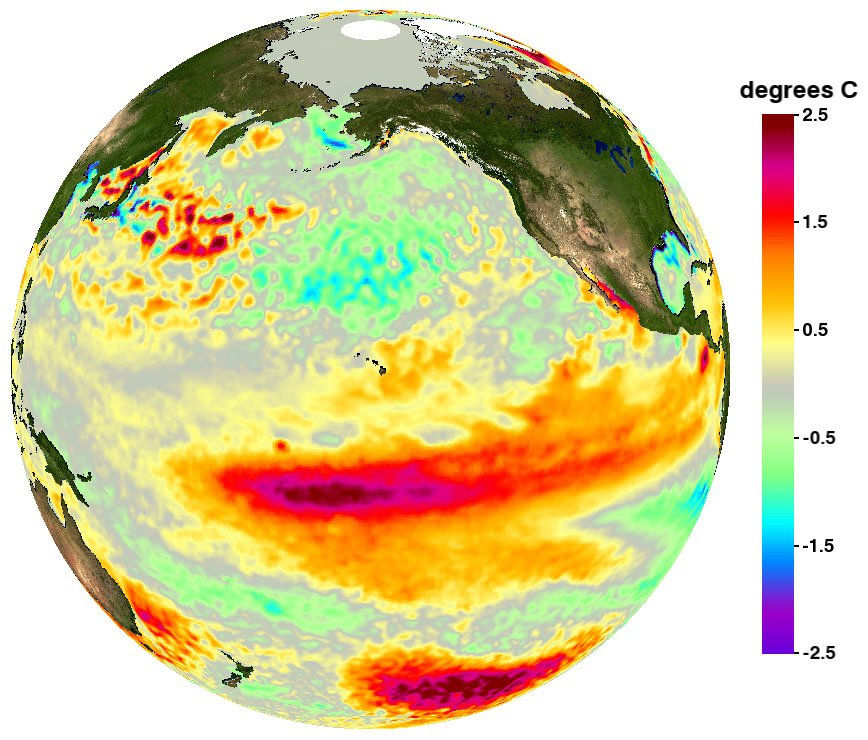
Warm surface temperature anomalies across the Pacific. A marine heatwave stacks a warm surface lens over cold, still-upwelling water below.
This is not a general "summer water is weird" story. This is about what makes this specific year behave the way it does, and why the science of it is bad news for visibility along much of the coast. Understanding the mechanism will make you a smarter diver for the rest of the season, because once you know what is driving the haze, you know exactly where to go looking for the clear water.
A Warm Lens Over Cold Water
Start with the temperature profile, because it is genuinely dramatic this year. Across Southern California this summer, the surface layer has been running warm, roughly 69 to 73 degrees on a lot of days. That is bathtub-adjacent for this coast, warm enough that plenty of divers have talked themselves into a thinner suit or even skins on the boat ride out.
Then you descend. Below the thermocline, down past roughly a hundred feet, the water is sitting around 54 to 55 degrees. That is not a gentle few-degree fade. That is a wall. You can feel the exact moment you punch through it, the way your exposed skin registers the change and your whole body tells you it did not sign up for this. Divers all along the coast are hitting a sharp, well-defined thermocline this year, and the gap between top and bottom is wide.
A warm surface sitting on top of cold deep water is not unusual by itself. What matters is why it is set up this way in 2026, and what that particular arrangement does to the water you are trying to see through.
The Warm Surface Did Not Shut Off Upwelling
Here is the critical point, and it is the hinge the entire post turns on. That warm surface lens has not shut off upwelling. Cold, nutrient-rich water is still being pulled up from the deep and delivered underneath the warm cap. The engine that feeds the bottom of California's food web is still running at full throttle.
That combination is the worst-case recipe for green water. Think about what a plankton bloom actually needs. It needs light and warmth at the surface to drive photosynthesis, and it needs a steady supply of nutrients to feed on. In a normal setup you rarely get both at maximum at the same time. In 2026 you do. The warm, sunny surface lens is a perfect greenhouse for plankton, and active upwelling underneath is a conveyor belt delivering the fertilizer. Warm sunny top, plus cold nutrient-loaded water arriving from below, equals a heavy, persistent plankton bloom and the green surface water so many divers are cursing right now.
So the same anomaly that gives you the deceptively tropical-feeling surface is also the thing feeding the murk. It is not two separate problems. It is one mechanism wearing two faces.
Not All Heatwaves Are Alike: The 2015 Contrast
This is the part that surprises people, and it is the most instructive piece of the whole story. A marine heatwave does not automatically mean bad visibility. It depends entirely on how the heat is distributed in the water column, and the last big one behaved almost exactly opposite to this one.
Cast your memory back to the 2015 to 2016 event, the one people nicknamed the "Warm Blob," stacked on top of a strong El Nino. That heatwave produced water that was, for many divers, clearer than normal, sometimes genuinely blue. Along the central coast, temperatures ran well above the usual range, into readings you would consider anomalously warm. And yet the water was often gorgeous.
Why? Because in 2015 the warmth reached down into the water column instead of sitting only at the top. When the deep water warms up, it becomes buoyant and stops rising the way cold water does, and upwelling gets suppressed. Choke off upwelling and you choke off the nutrient supply. No nutrients, no fuel for the bloom. The plankton starves. What you are left with is warm, low-nutrient, stable water, and that water tends to be clear. The Blob was warm all the way through, and that depth of warmth is exactly what starved the bloom and cleaned up the visibility.
2026 is the opposite regime. The warmth is a thin lid, not a deep soak. Warm only at the surface, cold and upwelling-active below. That maximizes bloom fuel instead of cutting it off. Same headline, "marine heatwave," completely inverted outcome for the water you dive in.
The Tell: Read the Temperature at Depth
If you take one practical diagnostic away from this, make it this one. When you want to know whether a heatwave is going to give you clear water or green soup, the surface temperature will not tell you. The surface is warm in both regimes. The answer lives at depth.
Warm at depth, the Blob-like pattern, means upwelling is suppressed and the bloom is starved, and you should lean toward expecting clearer water. Cold at depth, active upwelling, means the nutrient conveyor is running, the bloom has fuel, and you should expect haze at the surface and bloom risk everywhere shallow. It is the at-depth temperature that discriminates between the two regimes, not the number your wrist reads at three feet.
And 2026 has been stubbornly, persistently cold at depth. That mid-fifties water below the thermocline is the signature of a still-active upwelling system. It is the diagnostic proof that this year is the bloom-fueling regime, not the bloom-starving one. When you feel that cold hit you on the way down, that is not just an uncomfortable surprise. That is the ocean confirming why the top thirty feet look like split pea soup.
What This Means Off San Diego and La Jolla
Down south, around San Diego and La Jolla, the warm surface lens has been especially seductive and especially deceptive. You get a warm, inviting entry, sun cooking the surface, and a green tint that thickens as the season runs on. This is the region where divers are most tempted to under-dress for the surface temperature and then get punished at the bottom.
The shallow, near-shore zones are where the bloom hurts you most, because a shore diver working the top fifteen or twenty feet is living entirely inside the green layer. The bloom concentrates near the surface where the light is. If your whole dive happens up in that warm, well-lit band, you are diving in the murk the whole time. That is the frustrating irony of a warm-surface bloom year: the most comfortable water to be in is also the least clear.
The move, when you can make it, is to get down through the warm green cap and into the colder, cleaner water underneath, or to reach structure that sits deeper or further offshore where the bloom thins. The split that ruins your shallow dive is the same split that rewards you for dropping through it.
The Central Coast Stays Cold
Head north and the story shifts in an important way. The central coast does not get the tropical-feeling surface at all. Up there the water stays cold, top to bottom, with strong summer upwelling that keeps things chilly and, in the warmer months, blooming. Summer along the central coast is the season of cold, green, and often calm water, and calm does not help when the problem is a bloom that has nothing to mix it out.
It is worth holding both pictures in your head at once this year. In the south you have a warm deceptive lid over cold water and a bloom driven by that contrast. On the central coast you have cold water throughout and a bloom driven by classic summer upwelling. Different temperature stories, same green outcome, and in both cases the cleaner water is the colder water you have to work to reach. The through-line for 2026 is that warmth at the surface is not buying anybody good visibility.
Dress for the Cold You Will Actually Hit
Let the surface temperature be the last thing you trust this year. A 70-degree top does not mean a 70-degree dive. If your plan involves dropping through the thermocline, and this season the good water usually requires exactly that, you are diving in mid-fifties water for the meaningful part of the dive. Dress for that number, not the one you feel stepping off the boat.
Cold at depth does more than make you uncomfortable. Get chilled and your bottom time shrinks, your judgment dulls, and the dive you planned quietly shortens itself. The divers having good outings in these conditions are the ones who respected the split, suited up for the cold below, and were therefore willing and able to spend real time down where the water actually clears. Under-dress for the deceptive surface and you will bail out early, right when you were about to reach the water worth being in.
Playing the Split This Season
Put it all together and 2026 has a coherent strategy baked into its own physics. Expect a bloomy, green surface layer, and expect it to persist, because the mechanism feeding it is not going away as long as the warm lid and the active upwelling coexist. Do not read a warm, sunny, calm surface as a promise of clear water this year. That reading was true in some past heatwaves. It is exactly backward in this one.
Expect cleaner, colder water below the thermocline, and let that reshape your plan. The split rewards divers who drop through the green cap, and it rewards divers who reach deeper structure and boat-access spots that sit below or beyond the surface bloom. If your whole dive stays shallow, you stay in the soup. If you have a way down or a way out to structure, the same anomaly that fogged the shallows can hand you a clean, cold, and honestly beautiful dive underneath.
And keep reading the ocean the way this year is teaching you to. When the surface fools you with warmth but the depth bites you with cold, that is not a bad-luck dive. That is the 2026 signature, upwelling still on, bloom still fueled, and the good water waiting exactly where the warm lens ends. Once you can feel that story in the water, you stop fighting the conditions and start diving with them.
The Takeaway
2026's marine heatwave is a warm lens over cold water, and that split is the whole story. The surface feels tropical, the depth stays cold, and because the warmth never shut off upwelling, the bloom has everything it needs to turn the shallows green. Unlike the 2015 Blob, which warmed the water all the way down and starved the bloom into clear blue, this year's warmth is only skin-deep, and that is precisely why visibility has suffered. Read the temperature at depth, not the surface, to know which regime you are in. Then dress for the cold, respect the thermocline, and go find the cleaner water where the warm lens ends.
Photo credit: to be added
Image by NOAA (Public Domain)


Comments