


Spearfishing the Mendocino and Sonoma North Coast: Cold Water, Bull Kelp, and Big Lingcod


The Sonoma and Mendocino coast is California spearfishing at its rawest - cold, green, surging water against a backbone of rugged headlands and bull-kelp forests. For generations this was the heart of the state's free-dive abalone culture, and although that fishery is closed, the reefs that fed it are still here, full of big lingcod, rockfish, cabezon, and greenling. This is north-coast diving: demanding, beautiful, and worth the effort for those who prepare for it.

The North Coast Character
From Bodega Bay up through Mendocino and Fort Bragg, the coast is a series of rocky points, sea stacks, and pocket coves carved into bluffs. The water is cold and often green with nutrients, the swell is rarely small, and the kelp here is bull kelp - the towering single-stalk Nereocystis that forms seasonal forests rather than the surface canopy of the southern giant kelp. Visibility is typically more modest than the south, and the dive windows are short. What you trade in clarity you gain in productivity: these are some of the healthiest cold-water reefs in the state.
What You'll Find
The north-coast reef holds a classic cold-water lineup:
Big, aggressive, and abundant on the rocky structure - a signature north-coast target.
A deep and varied complex, with quality fish including prized species like the Lingcod.
Thick on the shallow rock and excellent eating, a north-coast staple.
Kelp and rock greenling tucked into the surge zones and rocky pockets.
A Word on Abalone
If you know this coast by reputation, you know it for abalone. For generations, the rocky points from Bodega Bay up to Fort Bragg were the heart of California's recreational red abalone fishery - a shore-pick and free-dive tradition, no scuba allowed, that drew divers north every spring and fall. Opening morning was a ritual: cold pre-dawn entries, an abalone iron, and a hard-won limit pried from the surge at the base of the kelp. For decades this was the only place in the state where you could legally take abalone at all, and for many North Coast divers it was the entire reason to own a thick wetsuit. That fishery is now closed - and understanding why, and how long it will stay that way, matters before you ever get in the water here.
How the Fishery Collapsed
The collapse was fast, and it was ecological rather than a simple story of overfishing. Beginning around 2013, sea star wasting disease swept the West Coast and all but wiped out the sunflower sea star, one of the main predators that had kept purple sea urchins in check. With that predator gone, urchin numbers exploded. At nearly the same time, a marine heatwave known as 'the Blob' settled over the Northeast Pacific from 2014 to 2016 and was followed by a strong El Nino, warming the water and starving it of the nutrients that bull kelp needs to grow. The result was a perfect storm: booming urchin populations grazing down a kelp forest that was already struggling to regenerate.
Within a few years, an estimated 90 percent of the bull kelp canopy along the Sonoma and Mendocino coast was gone, replaced by what scientists call urchin barrens - bare rock carpeted in purple urchins. Red abalone are kelp grazers, and when the kelp disappeared, they starved. Divers in the mid-2010s described abalone crawling into the open in search of drift kelp that was not there, shells gone slack against bodies that no longer filled them, and entire beds of dead and dying animals. Surveys documented steep declines in both abalone density and body condition. This was not a population that could absorb a recreational harvest stacked on top of an ecosystem collapse, and the state moved to take that pressure off.
From Emergency Closure to a Decade-Long Shutdown
The California Fish and Game Commission closed the abalone season starting in 2018. What began as a conditions-driven, supposedly temporary closure has been extended again and again as the kelp forest has failed to bounce back. The Department of Fish and Wildlife now manages the species under a Red Abalone Fishery Management Plan that ties any future reopening to measured abalone densities rather than to the calendar - the principle being that the fishery returns only when the population can actually support it, not simply when enough years have gone by.
The most recent action came in December 2025, when the Fish and Game Commission extended the closure once more. Recreational take of red abalone is now closed through at least April 1, 2036. Read that date carefully: it is not a scheduled reopening. It is the earliest point at which the Commission is willing to even revisit the question, and then only if recovery targets have been met. For any practical planning, treat North Coast abalone as off the table for the foreseeable future.
White and Black Abalone Are Protected Too
Red abalone were the only species that ever supported the recreational fishery here, but they are not the only abalone on this coast. White abalone hold the grim distinction of being the first marine invertebrate listed as endangered under the federal Endangered Species Act, and black abalone are listed as endangered as well. Both have been fully protected for decades, with captive-breeding and outplanting programs slowly working to rebuild wild populations. There is no legal scenario in which you take one. If you see any abalone on the North Coast - red, white, or black - treat it as a protected, recovering animal. Look, don't touch.
What This Means for You on the Water
The rules here are simple and strict. Do not take abalone, do not possess them, and do not pry one off the rock just to measure or admire it. The closure covers the entire coast and applies to free-divers and shore-pickers exactly as it applies to anyone else - carrying an abalone iron in your kit on these reefs is asking for trouble. If you witness poaching, and it does still happen, report it to CalTIP, the Department of Fish and Wildlife's confidential tip line. Layered on top of the abalone moratorium are the region's marine protected areas, including no-take reserves where nothing at all may be removed, so always confirm you are outside an MPA boundary before you hunt.
None of this should keep you off this coast. The North Coast still offers some of the best cold-water diving in California for the species this guide is built around - lingcod, the rockfish complex, cabezon, and greenling. Fill your bag with those, leave the abalone where they are, and confirm the current regulations with the California Department of Fish and Wildlife before every trip, because closures and boundaries do change.
Signs of Recovery
There is room for cautious optimism. Up and down the coast, restoration crews and volunteer divers have been culling purple urchins from priority reefs, and researchers are rearing sunflower sea stars in captivity with an eye toward eventually restoring the predator that was lost. Bull kelp has returned in patches in some seasons. The recovery is uneven and slow, which is exactly why the closure is tied to biology instead of a fixed date. If you dive the Sonoma and Mendocino coast over the next decade, you are diving a living experiment in kelp-forest recovery - and the most valuable thing a diver can do for the abalone's future is simply to let them be. Groups like the Reef Check California program and Greater Farallones Association have made the Sonoma and Mendocino reefs a focus of that work, and divers who log what they see contribute real data to it. Recovery on this coast will be measured in decades, not seasons, but every kelp stalk that comes back is a step toward the day the fishery might responsibly reopen.
Wildlife You'll Share the Water With
Cold, nutrient-rich water grows big animals, and the North Coast has them. Part of diving here is accepting that you are a visitor in a genuinely wild ecosystem - one with apex predators, massive marine mammals, and reef creatures you will not meet anywhere warmer. Knowing what shares the water with you is part of diving it safely and enjoying it fully.
Great White Sharks
The southern end of this coast, around Bodega Bay, marks the northern apex of the so-called Red Triangle - a stretch of California coast known for its white shark population. Adult white sharks move inshore through the fall to hunt seals and sea lions, which makes late summer through November the season to be most aware. Actual encounters are rare and bites are rarer still, but the honest approach is to dive with respect: avoid the water around seal haul-outs and rookeries, be extra cautious at dawn and dusk, keep a dive buddy and a float, and do not dive alone in low visibility near a pinniped colony. If you do see a white shark, stay calm, keep it in sight, and make a controlled exit. Treat the possibility as a reason for good habits, not a reason to stay home.
Seals and Sea Lions
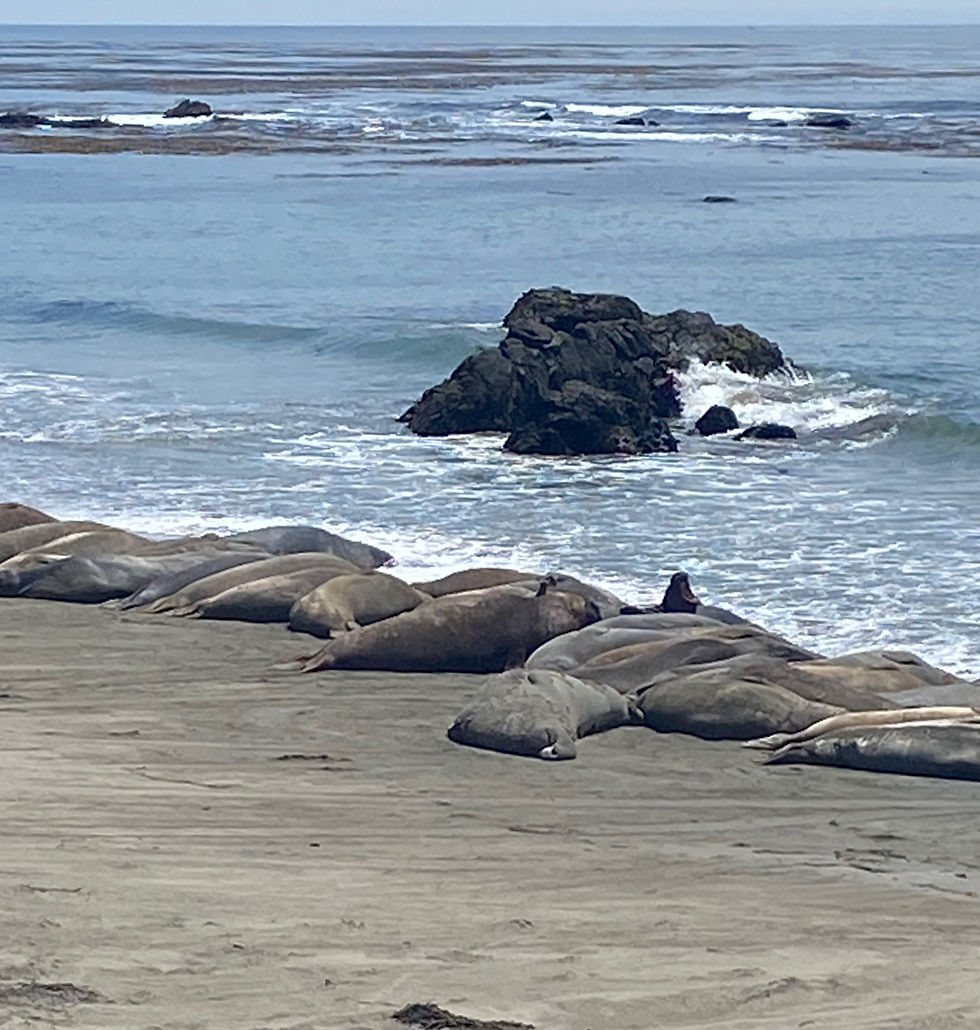
You are far more likely to share the reef with pinnipeds than with anything that worries you. Harbor seals are curious and will often shadow a diver, hanging just out of reach and occasionally nibbling at fins. California sea lions are faster, bolder, and more playful, and will sometimes buzz you at speed. Northern elephant seals - the giants of the group, with bulls topping two tons - travel along this coast and haul out on protected beaches; give them a wide berth on land, where they are both protected under the Marine Mammal Protection Act and genuinely dangerous if crowded. Beyond the spectacle, remember that concentrations of seals are exactly what draw white sharks inshore, so a beach loaded with hauled-out pinnipeds is worth factoring into where and when you get in.
Wolf Eels
One of the real treats of the cold-water North Coast reef is the wolf eel. Despite the name it is a fish, not an eel, and it lives wedged into rocky crevices and caves, often with just its wrinkled, oddly soulful face peering out. Wolf eels are generally docile and even curious, and many divers count a close look at one as a highlight of the dive. That said, they have powerful jaws built for crushing urchins and crabs, so admire them where they sit and keep your hands out of holes you cannot see into. A mated pair will often share the same den for years.
The cast does not end there. Schools of rockfish hang over the structure, Dungeness and rock crab work the bottom, and in season you may spot gray whales passing offshore or, more rarely, orcas. All of it is part of why this coast rewards the divers who put in the effort - just remember that the marine mammals are federally protected, the sharks deserve a wide berth, and the best policy with every animal here is to watch, not crowd.
Conditions and Access
North-coast diving means hunting calm windows and committing to cold-water entries. Practical notes:
Diveable days are limited and often come in fall, when swell and wind ease. Watch the forecast and be ready to move on a good window.
Access is through coves and trails - Salt Point, Stillwater Cove, Van Damme, Russian Gulch, Caspar, and the Mendocino headlands among the well-known entries. Scout the exit before you enter.
Cold water is non-negotiable gear: 7mm wetsuit or drysuit, hood, gloves, and booties, plus the fitness for surge and surf entries.
This region has white sharks present - factor that into your risk decisions, dive with a buddy, and use a float and flag.
Regulations and Marine Protected Areas
The north coast is dotted with marine protected areas, including no-take reserves like the well-known reserve at Gerstle Cove within Salt Point. Many famous coves are partially or fully protected, and the boundaries matter. Before you dive, check the current California Department of Fish and Wildlife MPA maps for your exact cove, confirm it is open to take, carry a valid license, and know the RCG complex limits and any depth or seasonal rules.
The Sonoma and Mendocino coast asks more of a diver than almost anywhere else in California - more patience, more cold tolerance, more respect for the ocean. Give it those things, time your window, mind the closures and the protected areas, and the north coast will show you the wild, productive reefs that built California's diving heritage.
Satellite and coastline imagery: screenshots from Google Earth.


Comments