


Why 2022 Was the Craziest Dorado Season in Southern California History

Updated: Apr 12
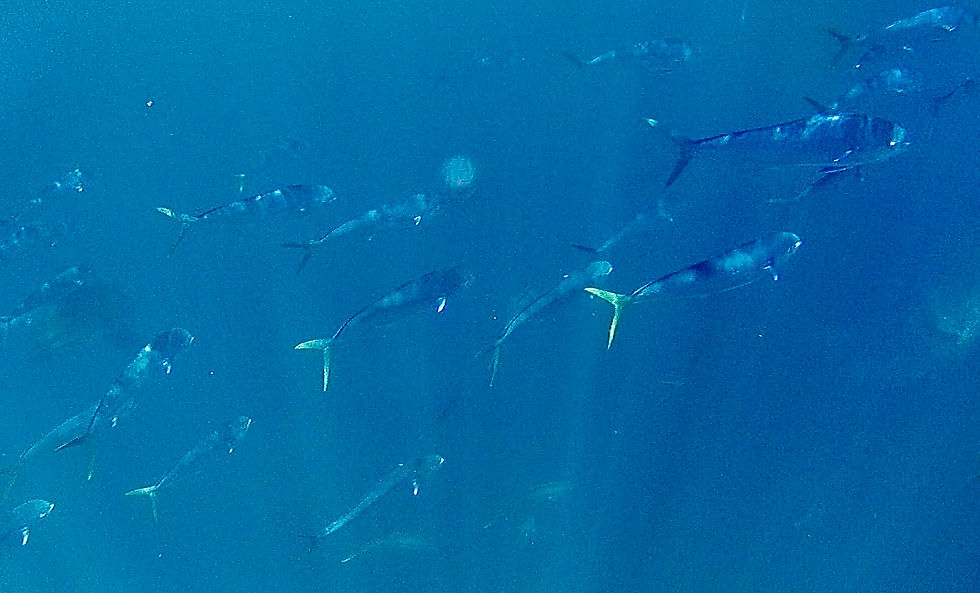
If you were anywhere near the water in Southern California during the summer of 2022, you already know. The dorado showed up in numbers nobody had ever seen before. Schools so massive they created foamers in local waters for the first time in memory. Half-day boats out of San Diego getting limits. And the whole thing happened during conditions that shouldn't have produced it at all.
I was out there spearing them myself, and even with 40 years of diving these waters, I'd never seen anything like it. Here's what actually happened and what caused it.
The Numbers Were Staggering
The San Diego CPFV fleet landed over 81,000 dorado during the 2022 season. In August alone, that number was 30,056. During one two-week stretch from August 21 to September 3, nearly 19,000 dorado came over the rail. The Islander saw 27 anglers land 162 dorado plus 72 bluefin, 55 yellowtail, and 53 yellowfin on a single three-day trip. A Ranger 85 outing produced 527 dorado for 28 anglers. BDOutdoors titled their year-end recap "The Year of the Dorado."
For divers, the opportunities were just as extraordinary. You didn't need to find kelp paddies or drift around hoping for a drive-by. Massive free-swimming schools were visible just under the surface, acres wide. If you could get offshore, you could find dorado.
First-Ever Dorado Foamers in Local Waters
Perhaps the most telling sign of how unusual 2022 was: dorado created surface feeding frenzies in the Southern California Bight. Prior to that summer, witnessing dorado foamers in local waters was described by veteran captains as "an anomaly." These are fish that normally show up around kelp paddies in ones and twos. In 2022, they were hunting in packs so dense they pushed bait to the surface and created the kind of blitz you'd expect from yellowfin or yellowtail.

The fish pushed from the Mexican border through the Catalina Channel and beyond. San Diego, Oceanside, Dana Point, Newport Beach, and Long Beach all had consistent action. AM and PM half-day boats were both producing limits, turning dorado from an overnight-trip target into something accessible to anyone who could get on a boat for a few hours.
It Wasn't Just Dorado
The warm-water push brought an entire ecosystem north. Yellowtail had a monster year with 83,335 caught seasonally. Yellowfin tuna were everywhere, with one Seaforth trip landing 103 for 35 anglers. Bluefin over 200 pounds were available west of San Clemente Island. Striped marlin were getting regular hookups. The San Diego Reader published an article in September asking whether dorado were being overfished given the extraordinary numbers.
The Paradox: It Happened During a La Nina
Here's where it gets interesting. Historically, the big warm-water invasion years have been tied to El Nino. The 2014-2015 El Nino produced what many called "the bite of the century" with confirmed wahoo, black marlin over 450 pounds, and giant yellowfin. But 2022 was in the middle of a rare triple-dip La Nina, with Oceanic Nino Index values ranging from -0.76 to -0.97. The Pacific Decadal Oscillation was negative. By every large-scale climate indicator, this was a cold year.
Marine Heatwaves Override Everything
Localized marine heatwaves overrode the basin-scale La Nina signal. NOAA confirmed marine heatwaves occurred in the northeast Pacific every year from 2019 through 2025. Warm-water eddies and countercurrents within the Southern California Bight pushed offshore temperatures to 71-73 degrees, right in the sweet spot for dorado. Then Hurricane Kay passed within 130 miles of San Diego in September, the closest tropical cyclone approach from the ocean side since records began in 1949, pushing warm water even further north.
The takeaway: ENSO alone doesn't predict warm-water species off Southern California. Marine heatwaves have become a recurring feature since The Blob first appeared in 2014. The fish follow the water temperature, not the climate index.
How 2022 Compared to 2015
The 2015 El Nino is still the gold standard for exotic species diversity. That year brought confirmed wahoo, blue and black marlin, and yellowfin exceeding 150 pounds from 600-800 miles south. But what 2022 lacked in diversity, it made up for in sheer biomass. Longtime captains said they could "not remember a season where so many dorado came into U.S. waters." If 2015 was the year of the exotics, 2022 was the year of the dorado.

What It Means for Future Seasons
Stop watching ENSO forecasts in isolation. Marine heatwaves have more impact on local species availability than whether the equatorial Pacific is in El Nino or La Nina. When offshore SSTs push above 68-70 degrees, the door opens for dorado, yellowfin, wahoo, and other warm-water species. Dorado are prolific breeders, fast growers, and highly migratory. When warm water pushes north and concentrates bait, they follow in numbers that are hard to comprehend until you see it.
If you missed 2022, the ocean has shown us these events are no longer once-a-decade anomalies. With marine heatwaves becoming more frequent and intense, the next historic dorado season could be closer than you think. Track SST anomalies using our live conditions tool at conditions.spearfactor.com. When offshore temps start climbing above 68 degrees in early summer, it's time to start watching for that green flash in blue water.
Photos: Bret Whitman / SpearFactor


Comments