


How to Choose Your First Speargun: A No-BS Buying Guide

Updated: May 10
Disclosure: As an Amazon Associate, SpearFactor earns from qualifying purchases. Some links in this post are affiliate links - using them costs you nothing but helps support the site.
Buying your first speargun is confusing. The market is flooded with options at every price point, forums are full of contradictory advice, and every brand claims their gun is the best. The result is that new divers either buy the wrong gun, spend too much on features they do not need, or spend too little on a gun that frustrates them into quitting.
This guide cuts through the noise. No brand shilling, no affiliate links, no trying to sell you the most expensive option. Just a straightforward breakdown of what matters, what does not, and how to pick a gun that matches your actual diving conditions and target species.

Band Guns vs. Pneumatic: The First Decision
Spearguns come in two fundamental types: band-powered and pneumatic (air-powered). In California, this is barely a decision at all.
Band Guns
Band guns use rubber bands (also called slings or power bands) stretched from the muzzle to the shaft to propel the spear. They are simple, reliable, easy to maintain, and account for the vast majority of spearguns used in California and worldwide. When someone says "speargun" without qualification, they mean a band gun.
Advantages: Simplicity, reliability, easy to repair in the field (carry spare bands), consistent power, wide range of sizes and configurations, most shops and divers can help you if something goes wrong.
Pneumatic Guns
Pneumatic guns use compressed air inside the barrel to propel the shaft. They are popular in parts of Europe and South America but are relatively uncommon in California.
Advantages: Compact size for their power output, no bands to replace, adjustable power on some models. Disadvantages: More complex mechanisms, harder to service, fewer local resources for repair, can lose pressure over time, some models are loud.
The Verdict
Buy a band gun for your first speargun. The California diving community, shops, and charter boats are all oriented around band guns. Parts, bands, and advice are universally available. Pneumatic guns are fine tools, but they are a niche choice that adds unnecessary complexity for a beginner.
Gun Materials: Wood vs. Aluminum vs. Carbon
Aluminum (Rail Guns)
Aluminum rail guns are the most common entry-level spearguns. The barrel is an extruded aluminum tube or rail, usually anodized for corrosion resistance. They are lightweight, relatively inexpensive, and widely available.
Pros: Affordable, durable, easy to maintain, widely available. Cons: They tend to be noisier in the water than wood guns (metal conducts and amplifies the band snap). They are also neutrally buoyant to slightly negative, which means they add weight to your dive setup. The tracking (how the shaft rides on the barrel) is generally good but not as refined as a well-made wood gun.

Wood
Wood guns are the traditional speargun material and still preferred by many experienced divers. They are typically made from teak, mahogany, or other hardwoods, and range from simple production guns to custom works of art.
Pros: Naturally buoyant (the gun floats once gun is fired and the shaft's out of it, if it's ballasted correctly), quieter than aluminum, better tracking due to the heavier barrel dampening vibration, can be very powerful, accurate, and they look great. Cons: More expensive than aluminum at every quality level, require more maintenance (oiling, varnishing), heavier to swing, and susceptible to water damage if the finish or laminate joining the wood together fails.

Carbon Fiber
Carbon fiber guns are the high-end option. They combine the positive buoyancy of wood with the precision of machined metal components, and they are extremely light and stiff.
Pros: Lightest option, positively buoyant, excellent tracking, very quiet, does not require the maintenance of wood. Cons: Expensive (typically $700+). Because they're lightweight, you can feel the recoil much more than a wooden gun, can be brittle if impacted, and you are paying a premium for marginal performance improvements over a good wood gun.
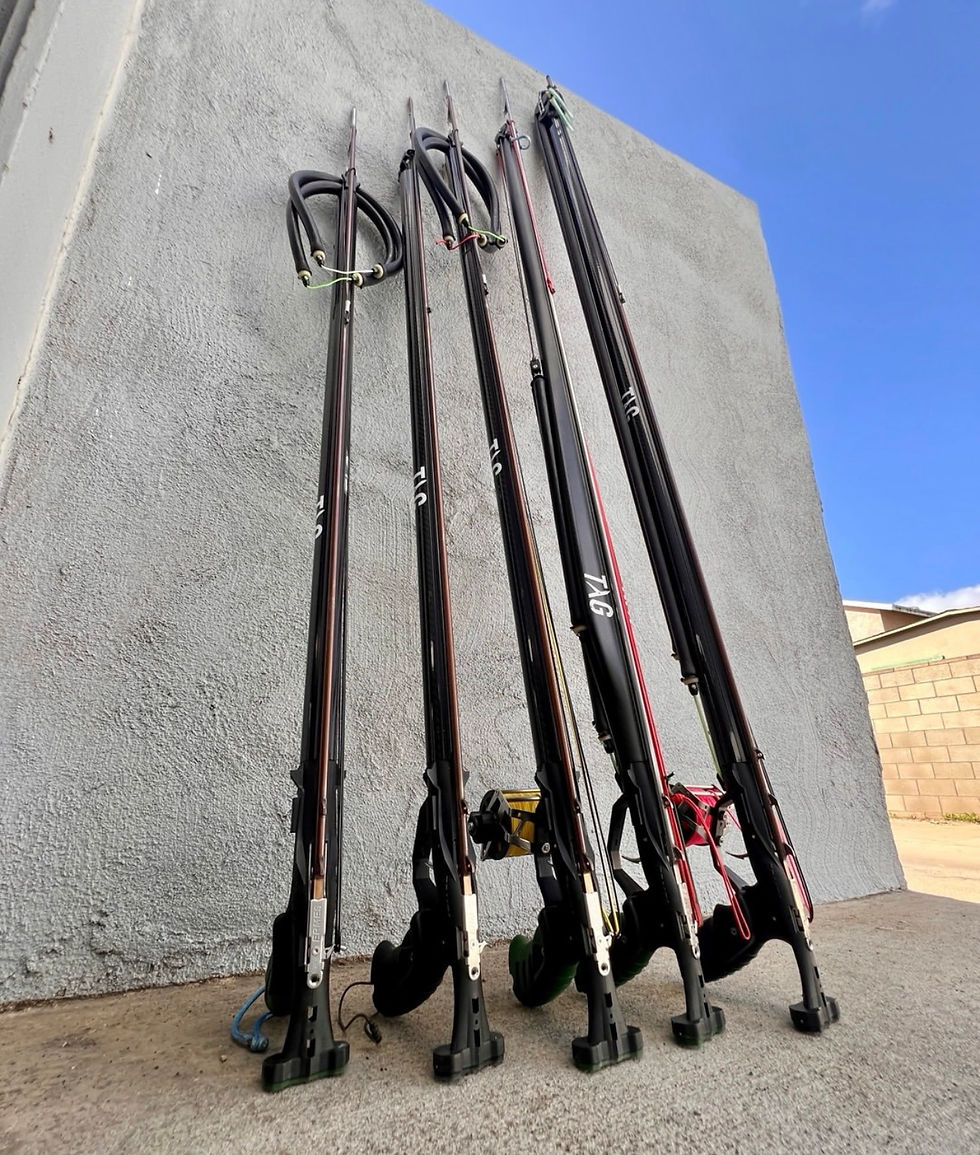
If you do eventually move toward the high end, custom builders are worth a look once you know exactly what you want. TAG Spearguns in San Diego builds carbon fiber guns with a breakdown travel design that is tough to beat if you fly with your gear. Hot Rod Spearguns builds handcrafted wood guns tuned for performance. Both are small-shop builders, and both cost more than a production gun for good reason. Bookmark them, finish learning what you actually want in a gun, then come back when you are ready to upgrade.
Material Recommendation for Beginners
For your first gun, either aluminum or wood is fine. If budget is tight, go aluminum. If you can afford to spend a bit more, go wood - the buoyancy and quieter operation are real advantages. Do not buy a carbon gun as your first speargun. You do not yet know what you like, and spending $800+ on a gun you might want to change in six months makes no sense.
Gun Length: The Most Important Decision
Gun length is measured from the muzzle to the butt of the handle, and it determines everything about how the gun performs. Longer guns shoot farther and more accurately at distance. Shorter guns are easier to maneuver in tight spaces and kelp. The right length depends on your target species and typical diving conditions.
60 cm: The Hole Gun
A 60 cm gun is essentially a short-range tool for poking fish in caves, ledges, and tight spaces. It is the gun you bring as a backup for lobster diving or for shooting fish in holes. Range is very limited (3 to 4 feet effective), but it excels in confined spaces where a longer gun physically cannot be aimed. Do not buy a 60 cm gun as your only speargun. It is too specialized.
75 cm: The Short All-Arounder
A 75 cm gun is the minimum length for a general-purpose California speargun. It has enough reach for open-water shots on reef fish at moderate distances (5 to 8 feet effective range) while still being maneuverable in kelp and around structure. This is a solid choice for a diver who primarily hunts calico bass, sheephead, sand bass, and other reef species in 10 to 20 foot visibility.
90 cm: The California Standard
If you could only own one speargun for California diving, a 90 cm gun is the one. It has enough reach for shots out to 10 to 12 feet, enough power for everything from calico bass to reasonable yellowtail encounters, and is still manageable in kelp forests and around structure. The vast majority of experienced California divers own a 90 cm gun as their primary reef gun. For a first gun in California, 90 cm is the strongest recommendation.
100-110 cm: The Big-Fish Reef Gun
Once you start targeting larger species - yellowtail, white sea bass, larger lingcod - a 100 to 110 cm gun provides the additional range and power you need. These guns shoot accurately out to 12 to 15 feet and carry enough energy to penetrate the heavier scales and flesh of big fish. The tradeoff is maneuverability. Most divers who own a 100+ cm gun also own a shorter gun for close-quarters work.
120+ cm: Bluewater Guns
Guns 120 cm and longer are bluewater tools designed for shooting tuna, wahoo, large yellowtail, and other pelagic species in open water with high visibility. These are typically double-band or triple-band guns with heavy shafts, long range (15 to 20+ feet), and serious penetrating power. Do not buy a 120+ cm gun as your first speargun unless you are exclusively doing bluewater diving from day one.
Single Band vs. Double Band vs. Triple+ Bands
Single-band guns are simpler, easier to load, and sufficient for most California reef species. A single 16mm or 18mm band on a 90 cm gun will cleanly kill any calico bass, sheephead, sand bass, halibut, or lingcod you encounter.

Double-band guns provide more power and range. The second band adds roughly 30% more velocity, which translates to better penetration on larger fish and additional effective range. Double bands make sense on guns 100 cm and longer that are intended for yellowtail, or possibly WSB. If I was going to go for a white sea bass with a double-banded gun, I would want to stick with keeping it less than 10 ft away to ensure penetration.
Triple bands and beyond are made for truly larger fish, 40 lb and up, which can consist of massive yellowtail, solid white sea bass, and blue water pelagics like bluefin tuna. If you're going for these, you're getting serious.
For your first gun, I would keep it around a 90 cm or less aluminum gun with one or two bands. It is easier to load, and the reduced power is actually an advantage - you are less likely to blow through a small fish and damage the shaft or lose your catch.
Shaft Thickness
6.25-6.5mm: Light and fast. Good for small reef fish in short-range situations. Bends more easily on reef shots.
7mm: The standard for California. Strong enough for most species, stiff enough to resist bending, compatible with the majority of guns and tips.
7.5mm: Heavy and strong. Intended for larger fish where penetration and holding power are priorities.
For your first gun, a 7mm shaft is the right choice.
Reel vs. No Reel
A reel is a spool of line mounted just in front of the handle of the gun that connects to the shaft via a shooting line. When you shoot a fish, the reel lets the fish run while staying connected to your gun. For your first gun, a reel is optional. If you are buying a 90 cm gun for general reef hunting in less than 30 ft of water, you can skip the reel and add one later when you start targeting larger species.
Floatline Setup for Bigger Fish
A floatline is a length of line (typically 50 to 75 feet) that connects your gun or shaft after firing to a surface float. For any fish that might exceed 10 to 15 pounds - yellowtail, white sea bass, large lingcod, tuna - a floatline setup is not optional. It is a safety requirement. The standard California setup is a 50-foot floatline connected to a torpedo-shaped float and if you're diving in the kelp, use a streamlining float such as a carrot float or a snake float.
Newer divers should invest in a float and dive flag from the start, even before they have a floatline. The dive flag is legally required in California when spearfishing from a boat, and having a float on the surface marks your position for boats.
Budget Recommendations
Entry Level: $200-$300
In this range, you are looking at aluminum rail guns from established manufacturers. This is a perfectly fine place to start. A $250 aluminum 90 cm gun with double band will kill fish just as dead as a $900 custom carbon gun. This is the right tier if you are unsure whether spearfishing is going to be your thing.
Mid-Range: $400-$600
This is the sweet spot for most serious beginners and intermediate divers. In this range, you can get a quality wood gun or a premium aluminum gun with better triggers, higher-quality bands, positive buoyancy, better shaft quality, and quieter operation. If you already know you are committed to spearfishing, buy in this range.
Serious: $700+
At $700 and above, you are in the territory of carbon fiber guns, custom wood guns, and high-end production guns. This tier makes sense for experienced divers who know exactly what they want. It does not make sense as a first gun purchase. Spend the extra money on dive trips, a good wetsuit, or fins instead - those investments will improve your catch rate far more.
What Features Actually Matter
Trigger mechanism quality: Should break cleanly without excessive creep or slack.
Shaft straightness: Roll the shaft on a flat surface - if it wobbles, reject it.
The gun's buoyancy and balance. You do not want the gun to be overpowered or too negative or positive buoyancy.
Tip system: Standard single-barb or tri-cut flopper tip is ideal for beginners. Slip tips are for large fish and not to be used around reefs and rocks.
The Bottom Line
For a first speargun in California, buy a band-powered gun in 90 cm with a single band possibly double and a 7mm-7.5mm shaft. Choose aluminum if you are on a tight budget, wood if you can spend a little more. Skip the reel for now, buy a float and dive flag, and spend the money you saved on dive trips and gas to the coast. The gun does not catch fish - the diver catches fish. A competent diver with a $200 gun will outperform an inexperienced diver with a $1,000 gun every single time.
Your first gun is a learning tool, not a lifetime investment. Get the gun, get in the water, and start diving. That is the only way to figure out what works for you.
Check Conditions Before You Go
Check current visibility, water temperature, and fish activity predictions at your dive spot using the SpearFactor Fish & Dive Conditions Tool.
Photo credits: My son, Hunter, with his 90cm two bands. "Beuchat Mundial Competition speargun" by Maximfil, via Wikimedia Commons (CC BY-SA 3.0). "Arbalete autocostruito" (handcrafted wooden speargun) by Affertus, via Wikimedia Commons (Public Domain). Cameron Gregg from TAG Spearguns produces some of the best quality carbon fiber guns out there.

Comments