


July 2026 California Diving Forecast: Peak Bloom, Finding the Windows

July is historically California's peak plankton bloom month. Warm surface water, abundant sunlight, and nutrient-rich upwelled water create optimal conditions for explosive algae growth. In most years, July's bloom is less severe than it appears because higher swell mixes the water column and breaks apart surface accumulations. But 2026 is different: the bloom started six weeks early (June), which means July will likely represent the peak intensity—and the conditions will hinge entirely on swell patterns.
This forecast examines what to expect in July, where divers can realistically hunt, which species windows are open, and how to plan a trip to California in the middle of summer without getting disappointed.
THE JULY BLOOM OUTLOOK: PEAK AND PERSISTENCE

If June's early bloom followed a standard seasonal curve, July will be the apex. Here's the marine biology: the bloom isn't limited by how much warm water or sunlight exists—both are abundant in July. The bloom is limited by nutrient depletion and water mixing. As the surface accumulation of plankton grows, it filters out light and consumes dissolved nitrogen, eventually triggering a die-off. But that takes weeks. More importantly, high swell and wind-driven mixing can break up surface accumulations in days.
The July wild card: Swell
Historically, July brings a mix of conditions—sometimes glassy and calm (worst for bloom), sometimes 4-8 ft swell (best for bloom disruption). In 2026, if July swell stays below 5 ft with light winds, expect the bloom to deepen and persist through the month. If a significant Southern Hemisphere groundswell arrives (6-8 ft+), expect 5-10 day windows of improved visibility as the water column mixes.
Water temperature projection:
Surface temps will likely peak in early-to-mid July (68-74°F San Diego, 64-70°F Monterey, 62-68°F central coast) before gradually cooling in late July as upwelling intensifies. At-depth temperatures will remain cold (51-56°F Monterey, 62-66°F San Diego at depth), maintaining the thermal sandwich that fuels bloom productivity.
The bloom chemistry:
Expect the heaviest accumulation in the top 15-20 ft. Below 25 ft, visibility should improve progressively with depth. At 40-50 ft, visibility in offshore zones could reach 20-30 ft even as surface conditions are pea soup. This depth-dependent clarity is the single most important tactic for July spearfishing.
REGIONAL FORECAST: WHERE JULY LOOKS DIVEABLE
SAN DIEGO (Mission Beach, Pacific Beach, Ocean Beach, Point Loma, La Jolla)
Shore-based (0-40 ft): POOR to MODERATE
Bay-mouth zones (Pacific Beach, Mission Bay, Ocean Beach) will remain compromised through early-mid July. Expect 2-6 ft visibility. These zones are the interface between coastal runoff and ocean water—during bloom season, they're the worst spots in Southern California.
However, Point Loma Kelp and offshore reefs should improve slightly as swell modulates. Target 5-10 day windows following larger swell events. Realistic visibility: 8-15 ft. Doable, not great.
Depth access (30-70 ft): GOOD
La Jolla Cove and La Jolla Shores will likely maintain 15-25 ft visibility at 30-50 ft depth throughout July. This is your reliable San Diego hunting ground. Species: calico bass and yellowtail, occasional white seabass, halibut in sandy zones. Small numbers, solid conditions. Plan for regular Tuesday-Friday diving when tourist crowds ease.
Offshore pinnacles (60-120 ft): EXCELLENT
Coronado Islands, San Clemente Island, Catalina Island, and Northern Channel Islands will maintain 20-30 ft plus visibility. This is prime hunting territory for White seabass, larger calico, and yellowtails. Conditions will actually improve if swell increases (mixing helps offshore sites more than shore sites). Boat access is required; expect to pay $150-250+ for a full day.
ORANGE COUNTY (Laguna Beach, Newport, Huntington, Crystal Cove)
Shallow coves (Shaw's, Crescent, Emerald): POOR
These won't improve much in July. Expect 4-10 ft visibility, worse on calm days, slightly better when swell picks up. Tourist hotspots and unreliable for hunting. The reef pockets in these areas offer localized improvements (15-20 ft in lucky spots), but the general picture is poor.
South-facing coves (Woods, Moss Point): MODERATE
More exposure to open-water mixing. Expect 8-16 ft visibility in good swell windows, 5-10 ft in calm periods. Crystal Cove's northern hunting zone (north of the SMCA boundary) will hold 10-15 ft with occasional 18-20 ft windows on fresh swell days. This is a wait-for-windows fishery—hunt the 2-4 day windows after swell events, avoid the calm periods.
Reef structure (30-60 ft): GOOD
Orange County's outer reefs (kelp edges, rocky transitions) accessed from shore or via short boat runs will offer 15-25 ft visibility. Calico bass, some halibut, rockfish. This is the sweet spot for Orange County hunters in July—work the deeper reefs where the bloom has less impact.
Boat-access offshore: EXCELLENT
Longer boat runs to open-water structure will see 25-35 ft visibility. Pelagic hunters (white seabass, larger calico) will find conditions excellent. Cost and logistics are the only limiting factors.
LOS ANGELES (Palos Verdes, Malibu, Santa Monica Bay, Redondo)
Santa Monica Bay & sandy beaches (Santa Monica, Redondo sand, Dockweiler): POOR
The open sandy stretches of Santa Monica Bay are the LA equivalent of San Diego’s bay mouths during bloom season—shallow, low-relief, and fed by urban runoff from Ballona Creek and the LA River outflow. Expect 3-8 ft visibility through July, worse on calm days. Not worth targeting for hunting.
Malibu points and coves (Point Dume, Leo Carrillo, Paradise Cove): MODERATE
More open-water exposure and rocky structure than the inner bay. Expect 8-15 ft in good swell windows, dropping to 5-10 ft in calm periods. Point Dume’s kelp and reef offer the best shot, with occasional 15-18 ft windows on fresh swell days. A wait-for-windows fishery—hunt the 2-4 day windows after swell events, avoid the flat calm.
Palos Verdes reefs (Malaga Cove, Lunada Bay, Christmas Tree Cove, Resort Point): GOOD
The crown jewel of LA shore diving. The rocky PV peninsula drops into kelp-lined reefs (20-60 ft) with strong water movement and enough depth access to drop below the surface bloom layer. Expect 12-22 ft at depth, with the deeper reef edges reaching 20-25 ft on clean days. Calico bass, halibut on the sand channels, sheephead, and rockfish. This is the sweet spot for LA hunters in July—work the deeper reef edges where the bloom has less impact. Entries are demanding (rock scrambles, surge), so respect the conditions.
Boat-access offshore & Catalina: EXCELLENT
Longer runs to offshore structure and the front side of Catalina Island will see 25-40 ft visibility—Catalina in particular sits far enough offshore to escape most of the coastal bloom. Pelagic hunters (white seabass, yellowtail on warm-water days, larger calico) will find excellent conditions. Cost and logistics (boat, crossing time) are the only limiting factors.
MONTEREY BAY (Santa Cruz, Carmel, Big Sur, Lover's Point)
Shore-based coves: POOR
Monterey in July is pea soup season. Expect 3-8 ft visibility in most popular coves through the entire month. This is the Monterey Paradox in full effect: summer warmth + active upwelling = maximum bloom. Few reliable windows. If fresh swell events occur (5-8 ft+), watch for 2-3 day windows of modest improvement (maybe 10-15 ft), but don't count on it.
Deep reef and kelp forest (40-80 ft): MODERATE
Descending to depth helps somewhat, but the bloom's nutrient richness means even deep water isn't pristine. Expect 10-20 ft at 50+ ft depth. Better than shore, but not exceptional. Deep kelp divers will find success with patience and planning.
Offshore pinnacles (Aumentos, Shale Island, Mt. Chetron, Metridium Mountain): GOOD
These sites typically hold 20-30 ft visibility in July. The mechanism: they're accessed seaward of the primary bloom accumulation zone, and they have strong water circulation. Boat access required; most divers work with CPFV services or private boats. Success probability is high for depth-capable hunters.
NORTHERN CALIFORNIA (Half Moon Bay, Point Arena, Fort Bragg)
General forecast: MODERATE
July typically offers slightly better conditions than the central coast, partly due to upwelling patterns and coastal geography. Expect 8-15 ft average visibility with occasional 15-25 ft windows. Shore-based coves will see the full range depending on swell and tide. Offshore sites will average 20+ ft.
This region is less affected by the 2026 early bloom than the south, so July should be relatively good compared to what San Diego and Orange County will experience. Plan accordingly: if you're flexible, consider northern California in July instead of San Diego.
JULY SPECIES WINDOWS: WHAT'S ACTIVE
One important caveat to the visibility-first mindset: not every target needs clear water. White seabass and halibut both hunt by senses other than sight and are routinely taken in green, murky water, and night hunting removes visibility from the equation entirely. So even in peak bloom you're not out of options—you just shift toward murk-tolerant species and low-light tactics instead of chasing clarity.
White Seabass - Spring Arrival, June Peak

White seabass are a spring-through-summer fishery: the first fish typically show up in spring, the run peaks around June, and by July you're just past the peak but they're still very much around. One important myth to correct: white seabass do not need clear water. They're croakers that hunt by sound and lateral line, and they'll happily hold in and along the murk—the edge where clean water meets dirty, green water is classic seabass ground. Gin-clear water can actually make them spookier, so you do not need 20+ ft of viz to hunt them. Temperature shapes where you'll find them in July: tagging studies (MacNamara 2025; Aalbers & Sepulveda 2015) put their sweet spot around 60–66°F, but July's surface runs well above that (upper 60s to mid 70s), so expect seabass to hold where the cooler water is—down along the thermocline, on the upwelling-influenced edges, and around the islands—rather than in the warm surface layer. That reinforces the depth-and-islands play for July. On timing, the moon is the big lever: seabass follow the squid, and squid spawn on the dark of the new moon, so plan your July trips around the new moon (four-year CPFV catch rates run roughly 5× higher at the new moon than the full moon). The full moon scatters the squid and slows the bite, though a strong feed can still come in the two to three days right after it. Beyond that, fish low light—dawn, dusk, and into the night—and moving tides, especially the incoming. In July, most of the fish push out toward the Channel Islands—San Clemente, Catalina, and the northern Channel Islands—where the water stays cooler than the warm mainland surface, and that's where the seabass concentrate while the mainland shore is fouled by bloom (the Coronados to the south are the other island option). Target depth: 30-80 ft near thermocline and around major structure.
Bag limit: 2 fish per angler (verify current regulations). Size limit: 28 inches minimum (verify with CDFW).
Best tactics: Boat access to offshore pinnacles (Coronado inslands, and Channel Islands, and really any kelp beds). Hunt early morning on fresh swell days. Expect frustration and long waits punctuated by explosive action.
Yellowtail - Warm-Water Wildcard
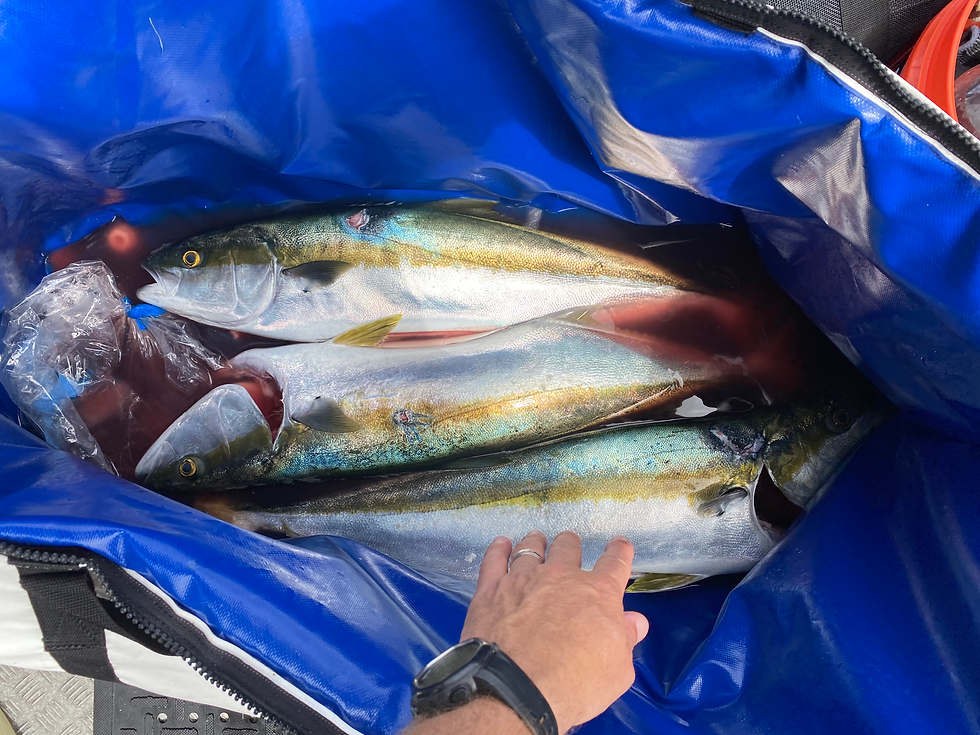
Yellowtail are pelagic migrants that push north into Southern California with warm water, and 2026’s marine heatwave is exactly the kind of warm-surface year that stacks them along kelp edges and offshore structure. July can deliver fast, aggressive “wide open” bites—often in a short early-morning window—around La Jolla kelp, the Coronado Islands, and offshore pinnacles. They roam constantly, so success is less about raw visibility and more about being on productive structure when a school moves through. That said, 15+ ft of clarity helps you track and intercept a moving school.
Two quick July notes: this is peak-volume season for yellowtail—mid-summer is when the most fish are in the water—and the overwhelming majority of California's yellowtail (well over 90% in the CDFW landings) come from the offshore islands and Baja, not the mainland San Diego coast. So in July, the Coronados, offshore kelp paddies, Catalina, and San Clemente Inlands are your percentage play, not the shore.
Bag limit: 10 fish, with no more than 5 allowed under 24 inches fork length (verify current regulations with CDFW).
Best tactics: Fish the early-morning window on kelp edges (La Jolla) and current-swept offshore structure (Coronado Islands, offshore pinnacles). Warm-water years like 2026 are prime—watch for temperature breaks and bird activity, and move with the schools rather than waiting them out.
Bluefin Tuna - The Offshore Prize

Bluefin are firmly in season in July—the Southern California fishery now runs roughly April through December, and it has exploded over the last several years. This is a pure offshore, boat-access game: they roam blue water around kelp paddies, temperature breaks, and bait far outside the coastal bloom, so inshore visibility is irrelevant to hunting them. Here's the July-specific key: with the surface running hot this month, don't chase the warmest water. Bluefin actually favor the cooler, upwelling-influenced blue water, and catch data shows the best action in the low-to-mid 60s°F—so work the temperature breaks and the cleaner, cooler side of them, not the hottest patch on the chart. Fish range from 20-lb “footballs” to giants well over 100+ lb, and a big one is a serious commitment of gear, boat, and skill.
Bag and size limits for Pacific bluefin are set annually and can change in-season—the fishery is quota-managed and has been subject to mid-season adjustments and closures in recent years. Always verify the current CDFW and NOAA/HMS regulations before you head out.
Best tactics: Long-range or fast offshore boat to the paddies and breaks (30-60+ miles is common). Work the temperature breaks and the cleaner, cooler blue water rather than the warmest patch. Hunt the early-morning window, run-and-gun to working birds and breaking fish, and be ready for open-water blue-water diving with proper gear, floatline setup, and safety discipline. One more nuance from the catch data: bluefin tend to be harder to locate around the dark of the new moon, so the brighter moon phases have historically fished better. This is the hardest common target on this list—expect long days for a single shot.
Wildcard: warm-water dorado (dorado/dolphinfish) are a late-summer possibility on offshore kelp paddies, but July is early and highly year-dependent—treat any that show as a rare bonus, not a target to plan a trip around.
Calico Bass (Kelp Bass) - Year-Round Staple

Post-spawn males still aggressive in July. Shallow rocky habitat (15-40 ft) holds good numbers. Visibility is the limiting factor. Hunt whenever vis exceeds 10 ft. Large numbers available if you can find clear-water windows.
Bag limit: 10 fish. Size limit: 12 inches.
Best tactics: Reef hunting in 25-40 ft range. Depth access from shore (Orange County, La Jolla) or boat access. July = good abundance, poor visibility = mediocre success rate.
Halibut - Sandy Zone Reliable

July halibut fishing is solid if you access the right habitat (sandy-rocky transitions) at the right depth (20-40 ft). Bay-mouth zones are blown out by bloom, but deeper sandy zones hold fish. Expect smaller numbers than spring, but still viable.
Bag limit: 4 fish. Size limit: 22 inches.
Best tactics: Target sandy transitions from shore (requires 40+ ft access) or boat to specific sandy habitat. Night hunting increases catch rates.
Giant Sea Bass - Protected Observation

Population recovery continues. July should see GSB activity similar to June—multiple interactions possible in prime spots (La Jolla Cove, kelp forests). Protected, observation-only, but excellent for wildlife watching and photography.
JULY TACTICAL PLAYBOOK: HUNTING IN THE PEAK BLOOM
Play 1: The Depth Gambit
Where the shore drops off to 40+ ft (La Jolla, outer reefs), descend aggressively. Spend bottom time at 40-60 ft where visibility improves. Risk: nitrogen narcosis, thermal stress, bottom time limits. Reward: clear water and hunting potential.
Best for: Calico bass, rockfish, occasional halibut. Calico-focused hunters should adopt this aggressively.
Play 2: The Swell Window
Monitor NOAA swell forecasts daily. When a 6-8 ft groundswell is forecast to arrive, book a dive or boat trip for day 2-4 of that swell. Water mixing improves visibility 5-10 ft typically. Short windows (2-4 days), high intensity, high payoff.
Best for: Large calico and other sight-hunting where clearer water helps you cover ground. White seabass don't require the clarity (see the species section), but a good swell window still makes for more comfortable, safer diving.
Play 3: The Nighttime Option
Visibility doesn't matter at night (artificial light). Halibut are active at night. Rockfish are accessible. Some calico bass hunting is viable. Safety requirements are higher (lights, navigation, buddy system). But conditions are independent of bloom.
Best for: Halibut, rockfish, photographers with dive lights. Medium risk, moderate reward.
Play 4: The Offshore Commitment
Book a boat (CPFV or private charter). Accept the cost ($150-250+ per person). Hunt offshore pinnacles where visibility is 25-35 ft and swell patterns actually help (mixing). Hunt white seabass, large calico, or diverse rockfish.
Best for: Any species. Highest success rate in July. Highest cost and commitment.
Play 5: The Geographic Escape
July in San Diego = bad. July in Monterey = mediocre. July in northern California = better. If you're flexible, drive north. Half Moon Bay, Point Arena, Fort Bragg will all outperform southern California in July. Different species, different logistics, same goal (find clear water).
Best for: Flexibility + tolerance for travel. Best visibility-per-effort ratio.
Play 6: The Bay Mouth Blacklist
Avoid Pacific Beach, Mission Bay, Ocean Beach, Newport Harbor, and similar bay-mouth zones. These are the worst visibility in California during bloom season. Permanently crossed off the July list.
Best for: Protecting your vacation time. Don't waste it.
SWELL PREDICTION: THE JULY CURVE
Historically, July sees a modulating swell pattern: calm to 2 ft early July (worst for visibility), 4-6 ft mid-July (better), variable late July (improving as weather systems approach). The frequency of 6-8 ft swell events in July is typically low (1-3 events).
2026 note: Monitor NOAA/NDBC forecasts daily. If July produces higher-than-average swell, conditions will improve significantly. If calm, expect the worst bloom persistence of the summer.
TRAVEL PLANNING FOR JULY 2026
Best bets:
Offshore (San Diego, Monterey): Book a boat. Expect $150-250 per person. Excellence guaranteed if you're depth-capable.
La Jolla: Daily dives, 30-50 ft depth, 15-25 ft visibility. Consistent, accessible, reliable.
Northern California: Point Arena, Fort Bragg. Better shore-based conditions than the south.
Swell window chasers: Monitor forecasts, be flexible, hunt 2-4 day windows after swell events.
Avoid:
San Diego bay mouths (Pacific Beach, Mission, OB).
Shallow Laguna coves (Shaw's, Crescent, Emerald).
Monterey cove diving without depth/offshore access.
Expecting great visibility without depth capability or boat access.
Realistic expectations:
San Diego shore: 5-12 ft average, occasional 15+ ft windows.
Orange County reef: 10-18 ft average with swell modulation.
Monterey offshore: 20-30 ft consistently.
Northern CA: 12-20 ft average.
Offshore pinnacles anywhere: 25-35 ft, excellent.
THE SPECIES CALENDAR FOR JULY
Species | Prime Window | Best Tactic | Difficulty
White Seabass | Spring–June peak, into July | New moon, low light, 60-66°F | Hard
Yellowtail | Jun–Sep (warm years) | Offshore, kelp edges | Medium
Bluefin Tuna | Apr–Dec, summer-fall peak | Offshore blue water, temp breaks | Very Hard
Calico Bass | All month | Depth, reefs | Medium
Halibut | All month | Sandy zones, night | Medium
GSB | All month | Observation, La Jolla | Easy
JULY COST-BENEFIT ANALYSIS
Shore-based hunting:
Cost: Gas + parking + lunch = $30-60
Expected visibility: 8-15 ft
Expected catch: 0-3 fish depending on species and effort
Success rate: 40% (you'll find something diveable 2 out of 5 trips)
Verdict: Budget fishing, moderate success. Good for practice, learning, local exploration. Risky for vacation divers.
Boat hunting:
Cost: $150-250 per person + transportation
Expected visibility: 25-35 ft
Expected catch: 2-5 fish depending on species and effort
Success rate: 85% (excellent odds)
Verdict: High investment, high confidence return. Best option for vacation divers in July.
Depth-access shore hunting (La Jolla, deep reefs):
Cost: Gas + parking = $20-50
Expected visibility: 18-25 ft (at depth)
Expected catch: 2-4 fish
Success rate: 70% (very good odds)
Verdict: Sweet spot. Moderate cost, good visibility, reliable success. Requires training/experience.
MID-SUMMER MINDSET: JULY REALISM
July is the toughest month to plan a California diving trip. The bloom is at peak intensity. Visibility is the most limiting factor. Successful hunters in July have either:
Deep-dive training and local shore access
Boat access and budget for it
Flexibility to chase swell windows
Realistic expectations and low pressure
If you're planning a July trip to California and expecting epic shore-based cove diving with 30-ft visibility and epic fish counts, reset your expectations. That doesn't happen in July (unless you get extremely lucky with swell windows).
If you're flexible on timing, shift to September-October. If you're committed to July, invest in boat access or develop depth-dive skills.
THE SILVER LINING
July's bloom means fewer casual divers and spearfishers in the water. Fish stocks experience reduced hunting pressure. The divers who do venture out in July are serious, trained, and selective. This creates a less-crowded experience for those committed to hunting regardless of conditions.
Additionally, July is the most predictable month of the year—it's always bloomy, so you can plan around it. The surprise good-viz days in July are better than the surprise bad-viz days in June.
LATE JULY OUTLOOK: WHEN DOES IT BREAK?
Historically, late July (last week) shows the first signs of bloom breakdown as upwelling transitions to other patterns and nutrient depletion sets in. Water-mixing from swell events accelerates this. By late July, some regional improvements might be visible: Monterey might see 15-20 ft instead of 5-10 ft. San Diego might see consistent 12-18 ft instead of 5-12 ft.
But don't count on it. The forecast horizon only extends reliably to mid-July. After that, daily monitoring of actual conditions is essential.
THE BOTTOM LINE FOR JULY 2026
July is the peak bloom month. Visibility will be the single limiting factor. Divers who can access depth (40-60 ft), have boat access, or have flexibility to chase swell windows will succeed. Shore-based hunters in shallow water will struggle.
Plan accordingly: invest in boat time, develop deep-dive skills, build a realistic catch expectation, and accept that July is a working month, not a vacation month, for California diving.
The reward for succeeding in July: by August and September, when the bloom finally breaks, you'll be ready to exploit the clearing trend and experience the best diving season of the year.
Forecast data compiled from NOAA climate modeling, historical bloom patterns (2019-2026), water temperature profiles, and swell prediction models current as of June 27, 2026. Actual July conditions may vary. Monitor real-time visibility reports and NOAA forecasts daily for tactical planning. Photo credit: NOAA satellite imagery and SpearFactor climate database.
Image credits: West Coast phytoplankton bloom by MODIS Rapid Response, NASA GSFC (public domain); white seabass by Patrick Cox / iNaturalist (CC BY 4.0); kelp bass by Steve Lonhart / MBNMS (public domain); California halibut by RatioTile (CC BY-SA 4.0); giant sea bass by Donald Davesne / iNaturalist (CC BY 4.0); California yellowtail by Zoefricker (CC BY-SA 4.0); Pacific bluefin tuna by Stephane-bdc (CC BY-SA 4.0). All images via Wikimedia Commons.


Comments