


Moon Phases and Spearfishing: How to Time Your Hunts Around the Lunar Cycle

Updated: Jun 9
The moon drives the tides, the tides drive water movement, and water movement drives fish behavior. Divers who learn to read the lunar cycle pick up an enormous edge in timing their dives - the difference between a hard-charging school of yellowtail on a moving tide and a dead reef at slack water can come down to which moon phase you happened to pick.
This guide covers how the four major moon phases affect fish behavior, which species respond strongest, and how to plan a dive trip around the lunar calendar.
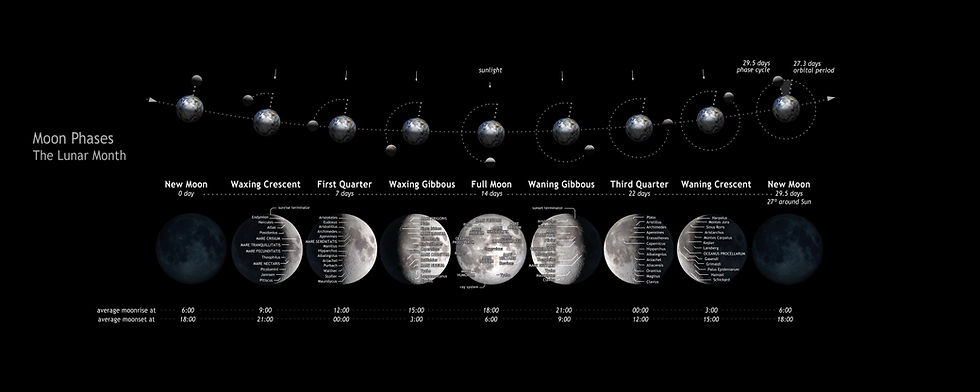
The eight phases of the moon's 29.5-day cycle. New and full moons produce the strongest tidal swings (spring tides); first and last quarters produce the weakest (neap tides).
The Four Phases
New Moon
The new moon produces the strongest tidal swings of the month (the spring tides). Water moves harder, faster, and further between high and low. For divers, this means:
Strongest current of the cycle - challenging for shore divers, productive for drift hunters
Peak feeding activity on tide changes - fish stage and feed aggressively
Higher water clarity in many areas as bigger tide flushes push out cloudy nearshore water
Best week of the month for white sea bass on California squid grounds - they spawn around new moons
Plan a new moon week around the squid run for WSB, around offshore current edges for yellowtail, and around drift-dive opportunities at point breaks.
First Quarter (Waxing Half Moon)
Tidal swings are moderate - the neap tides between new and full. Currents are softer, water movement is gentler, and fish are generally less aggressive. This phase is fine for casual diving but not the peak of any species' feeding window.
Full Moon
Like the new moon, the full moon produces strong tidal swings (spring tides). Behavior overlaps with new moon in many ways, but with a critical difference for night-feeding species:
Bright moonlight at night - many predators feed at night under a full moon, which means they are less aggressive during the day
Lobster hunters often see slower full-moon nights as lobster come out less under bright light
Day diving is still productive for white sea bass, yellowtail, and reef species, especially on tide changes
Open-water pelagics often feed less aggressively during the day after a heavy moonlit feeding night
Last Quarter (Waning Half Moon)
Like the first quarter, tide swings are moderate. Less productive than spring tides but more comfortable for shore diving. A reasonable window for new divers learning structure hunting without strong current to fight.

When the Sun, Moon, and Earth align at new moon (and again at full moon), the gravitational forces combine to create spring tides - the strongest water movement and the most productive predator-feeding windows.
Species-Specific Lunar Patterns
White sea bass: peak around new moon when squid are spawning. The 3-4 day window leading into a new moon is the most productive of the month
Yellowtail: active on strong tides regardless of phase, but new and full moons produce the biggest moves of fish
Lobster: harder to find on bright moon nights, peak activity on dark nights (new moon especially)
Calico bass: less moon-sensitive than offshore species, productive any tide change
Halibut: feed on tide changes regardless of phase but flush stronger on spring tides
Tuna: often associated with specific moon phases by experienced offshore divers, with full moon nights producing aggressive surface feeding the following day
California's Big Three: White Sea Bass, Yellowtail, and Bluefin
For California divers, three species drive most serious moon-phase planning: white sea bass, yellowtail, and bluefin tuna. Each responds to the lunar cycle differently, and getting the timing right on each one is the difference between a productive trip and a wasted weekend.
White Sea Bass
White sea bass are the most moon-sensitive species in California waters. Their feeding pattern is locked to the squid spawn, and squid spawn around the new moon - so WSB feeding follows the lunar calendar almost like a clock.
Peak window: the 3-4 days leading up to and including the new moon during squid season (March through July)
Squid biology: market squid (Doryteuthis opalescens) aggregate to spawn on shallow sand beds during the dark nights around the new moon. WSB pile in to eat the eggs, the dying spawned-out adults, and any predators that show up
Full moon secondary window: still productive, especially for divers who arrive at first light when the moon is setting and squid are still on the beds
Quarter moons: slow. The squid are not actively spawning, the WSB are not concentrated, and the bite is far less predictable
Time of day: dawn and dusk produce the biggest fish during a new moon week. Midday still produces fish but the trophy class moves at the light edges
Catch data from California spear and rod fisheries confirms the pattern: the overwhelming majority of WSB catches happen at or near squid beds during the spawn cycle. If you only get a few WSB dive days per season, plan them around new moons in April through June.
Yellowtail
Yellowtail are less locked to specific moon phases than WSB, but they are highly responsive to tide movement - and tide swings are biggest on spring tides (new and full moons). The result is that yellowtail feed best on spring tides regardless of which phase produces them.
Peak windows: 3-day window centered on the new moon AND 3-day window centered on the full moon, year-round
Why both phases work: yellowtail are pelagic and current-driven. Spring tides produce strong current edges, bait concentrates at those edges, and yellowtail patrol them aggressively
Less time-of-day dependent than WSB: yellowtail will feed throughout the day on strong tides, though early morning and late afternoon still produce the most action
Neap tide caveat: first and last quarter weeks can be productive but require finding the specific tide change windows - the overall feed is less aggressive
Seasonal nuance: spring yellowtail (April-June) hold structure tighter and are more current-dependent than summer/fall yellowtail (July-October), which means moon phase matters more in spring than in the warmer months
Bluefin Tuna
Bluefin tuna are the most complex of the three. Their feeding is driven by bait movement, water temperature, and currents - all of which interact with moon phase but none of which are determined by it alone.
Full moon paradox: bluefin feed aggressively at night under a bright full moon, which often translates to SLOWER daytime feeding the following day. Many bluefin captains plan trips for the 2-3 days AFTER a full moon when the fish are hungry again from the nighttime burn
New moon advantage: dark nights mean less nighttime feeding, which often produces harder daytime bites. New moon weeks are generally considered prime for daytime bluefin spearfishing in California
Spring tide upwelling: new and full moons produce strong upwelling along the California current edges, concentrating bait and pulling bluefin closer to shore. The trip window can extend several days past the peak phase as upwelling effects settle
Surface vs. deep behavior: full moon fish often hold deeper during the day; new moon fish tend to push higher in the water column. Adjust your gun and rigging accordingly - longer guns and slip tips for deep daytime full-moon fish, shorter guns for higher-in-the-column new-moon work
Stacking the Variables
These patterns are guidelines, not guarantees. A strong tide on a new moon during the squid spawn for WSB is the highest-probability combination California offers - but it can still produce a skunk day if the water is dirty, the temperature is wrong, or the bait simply did not show up. Plan around the moon when you can, but accept that the moon is one input among many. The divers who do best stack the variables: new moon, plus moving tide, plus right temperature, plus historical productivity at the spot.
Planning a Trip Around the Moon
If you can pick the dates, plan a serious spearfishing trip around a new moon or full moon week:
California white sea bass: target the 3-4 days leading up to and including the new moon, March through July
California yellowtail: peak action on spring tides, plan trips to align with new or full moons in summer
Mexico pelagics: new moon weeks tend to fish best for tuna, wahoo, and dorado
Lobster: target dark nights around the new moon for best opening-night results
When Moon Phase Does Not Matter
Some scenarios where the moon matters less:
Strong consistent currents (like the Channel Islands) override lunar tidal effects
Inland water spearfishing (where allowed) responds more to water temperature than moon phase
Stationary reef species with no migration pattern - calicos and sheephead in a kelp forest do not care about the moon
Sites with minimal tidal range (like inland seas or lakes)
Frequently Asked Questions
What moon phase is best for spearfishing?
New moon and full moon both produce spring tides - the strongest tidal swings of the month - and predator fish feed most aggressively on those tide changes. New moon is best for white sea bass during squid spawn season and for daytime bluefin. Full moon often slows daytime pelagic activity because fish fed overnight, but reef diving stays productive.
Why are white sea bass so tied to the new moon?
Market squid spawn on shallow sand beds during the dark nights around the new moon. WSB pile in to feed on the squid, the eggs, and the spawned-out adults. The 3-4 day window leading into a new moon during squid season (March-July) is the most productive WSB window of the month.
Does moon phase matter for lobster diving?
Yes. Lobster are most active and easiest to find on dark nights - peak activity around the new moon. Bright full-moon nights slow lobster movement noticeably. Plan opening-night and key hunting nights around the new moon for best results.
How far before and after a peak moon phase is fishing still good?
Plan on a 3-4 day window centered on the peak phase. Tidal swings are strongest the day of the new or full moon but stay significant for 1-2 days on either side. For bluefin specifically, the 2-3 days AFTER a full moon often fish better than the day of, because the fish are hungry again after a heavy moonlit feeding night.
Check Conditions Before You Go
Check current visibility, water temperature, and fish activity predictions at your dive spot using the SpearFactor Fish & Dive Conditions Tool.
The Edge of Knowing
Moon phase is one of the most underused planning tools for spearfishing. Free apps and tide charts give you the data; learning what to do with it is the edge. Plan your most important trips around spring tides, target species with documented lunar patterns at their peak phase, and accept that the moon is one variable among many - but a variable you can predict months in advance, which is more than you can say for most of them.
Image credits: Moon phases diagram by Unmismoobjetivo, via Wikimedia Commons (CC BY-SA 4.0). Sun-Moon-Earth spring tide diagram by Lookang, via Wikimedia Commons (CC BY-SA 4.0).
Related Reading
How to Read Ocean Conditions Before You Dive: A Diver’s Guide to Swell, Wind, Tide, and Visibility
WSB Squid Bed Tactics: How to Hunt the June 14 New Moon Spawn Window
Late-Spring Yellowtail in California: Schools Pushing North and Where to Find Them
Reading Tides for California Spearfishing: Slack Water, Flow Direction, and Bait Behavior


Comments