


Spearfishing Knots: The 5 Essential Knots Every Diver Should Know
- Bret Whitman

- Jun 5
- 4 min read
Knot work is one of the most underrated skills in spearfishing. The diver who can tie the right knot quickly in the right situation has an edge in rigging speed, gear repair, and emergency response. The diver who learned five knots in scout camp 30 years ago and never tied any since is one bad day away from a rigging failure that ends a trip. The fix is simple - learn five specific knots, practice them until they are automatic, and use them throughout your spearfishing rigging.
This guide covers the five knots that handle 95 percent of what a diver needs to do with line and cord.
Why Knots Matter Specifically in Spearfishing
Shooting line rigging - the connection between shaft, line, and gun is load-critical
Float line connections - failure means a lost float and possibly a lost fish
Quick-release setups - need to come undone fast under pressure
Emergency repairs - mid-trip break of bands, lines, or shooting line
Slip-tip rigging - the line release and slip-tip retention both depend on knot choice
Knot #1: The Bowline

The bowline knot. Forms a fixed loop that holds under load but unties easily after.
The single most important knot for any diver to know. Creates a fixed loop at the end of a line that does not slip under load and can be untied even after heavy stress.
Use cases: attaching float lines to floats, creating loops on bungee, emergency rescue handles
Strengths: holds well under load, easy to untie after stress, simple to learn
Weaknesses: slow to tie until automatic, can shake loose if not loaded (back up with stopper knot if needed)
Practice goal: tie reliably with eyes closed in 5 seconds
Knot #2: The Uni Knot (or Hangman's Loop)
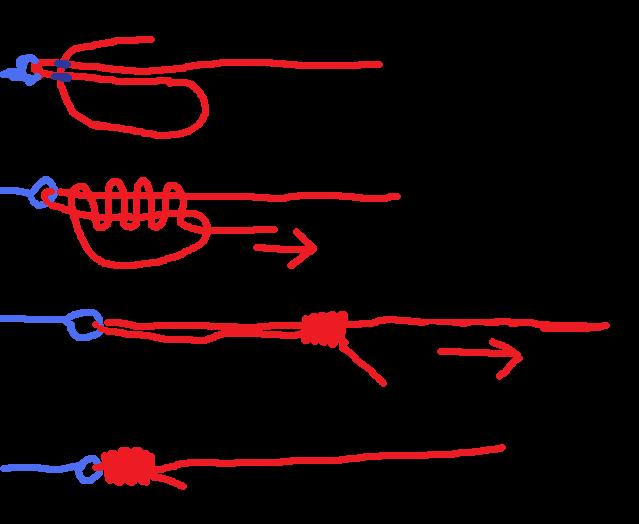
The Uni knot (also called the Hangman's loop). Among the most reliable knots for tying monofilament or braid to terminal tackle.
The workhorse fishing knot, equally useful in spearfishing for any line-to-hardware connection.
Use cases: attaching shooting line to slip tips, line to swivels, mono to fluoro, any line-to-hardware connection
Strengths: retains 90-95 percent of line strength when tied correctly, works in mono, fluoro, and braid
Weaknesses: requires the line to pass through the hardware eye - cannot use for closed loops
Practice goal: tie reliably in any line type in 10 seconds
Knot #3: The Double Surgeon's Knot
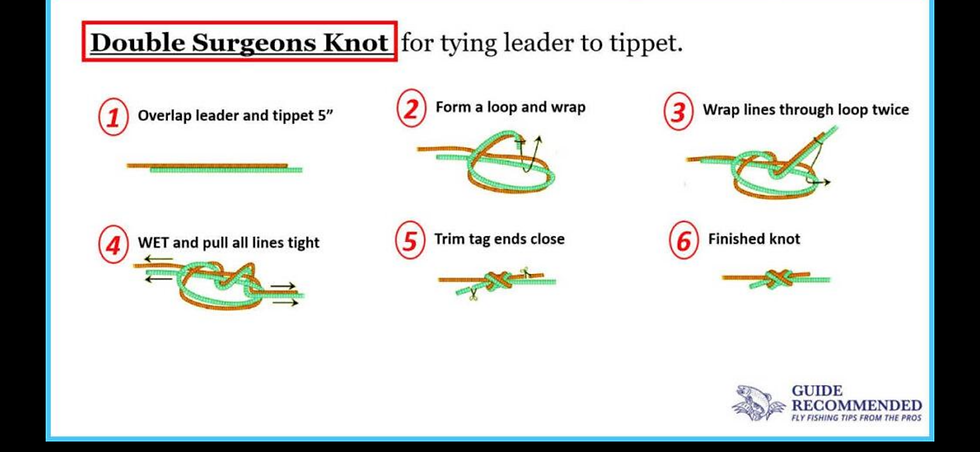
The simplest reliable line-to-line connection. Used for joining two lines together, especially of different diameters.
Use cases: extending shooting line, joining bungee to mono, field-repair of broken line
Strengths: easy to tie, holds well, works with different line diameters
Weaknesses: bulkier than other line-to-line connections, can catch on guides
Practice goal: tie in 15 seconds with wet hands
Knot #4: The Constrictor Knot

The constrictor knot in four tying steps. Once tightened it grips so firmly it usually has to be cut off rather than untied.
A semi-permanent gripping knot that tightens under load and resists slipping. Used for binding hardware to line.
Use cases: securing slip tips to shooting line, holding band wishbones in place, binding gear in field repairs
Strengths: extreme grip, does not loosen under variable load, can be tied around an object
Weaknesses: extremely difficult to untie - typically must be cut off. Use only where the connection is meant to be permanent
Practice goal: tie one-handed under tension
Knot #5: The Quick-Release Slipped Hitch

A slipped hitch (buntline variant shown). The defining feature is the quick-release loop on the tag end that unties the knot with one pull.
Any knot designed to come undone with a single pull on the tag end. Multiple variations exist (slipped clove hitch, slipped buntline, etc.). The principle is more important than the specific variant.
Use cases: temporary float line attachments, gear that needs to come free fast in emergencies, line-to-anchor connections in current
Strengths: holds under load, releases instantly with one motion
Weaknesses: can release accidentally if the tag end snags
Practice goal: tie and release in 5 seconds, in cold-wet conditions
How to Actually Learn These
Use real rope on dry land at first - practice while watching TV, not at the boat ramp
Practice each knot 50 times before moving to the next
Practice with wet, cold hands - the knot you can tie in the kitchen is not the same as the knot you tie on a cold boat
Practice one-handed when possible - your other hand may be holding the gun, the fish, or the boat
Time yourself - speed matters in emergency situations
Re-practice annually - knots fade from muscle memory if not refreshed
Knots to Skip (And Why)
Granny knot / square knot: looks reliable, fails unpredictably under load. Skip in favor of bowline or surgeon's knot
Overhand knot for rigging: weakens line significantly. Acceptable only as a stopper, never as a structural connection
Improvised knots: under pressure, divers regress to known knots. Improvising in the moment is how rigging fails
Resources for Visual Learning
Animated Knots by Grog (animatedknots.com) - the gold-standard knot reference
YouTube tutorials for each specific knot - visual repetition cements the technique
Local dive club instructors often run knot-tying nights for members
Practice knot board mounted in your garage or workshop - 5 minutes per day for two weeks builds the foundation
Why These Five Are Enough
Most divers who know these five knots cold can handle any rigging or repair situation that comes up in a typical California or international spearfishing trip. Specialized knots have their place for advanced rigging, but the five above cover the foundation. Drill them, refresh them annually, and you carry the rigging toolkit in your hands instead of having to remember which YouTube video you watched a year ago. The skill costs nothing to maintain and pays back every trip.
Image credits: Bowline knot by USCG PTC Developer, via Wikimedia Commons (CC BY-SA 4.0). Uni knot by Snapper G, via Wikimedia Commons (CC BY-SA 3.0). Constrictor knot four-step diagram by David J. Fred, via Wikimedia Commons (CC BY-SA 2.5). Slipped buntline hitch by Jeremy Cooper (Ke6jjj), via Wikimedia Commons (CC BY-SA 3.0). Double Surgeon's Knot by Guide Recommend Fly Fishing trips.


Comments